










In Malaysia, Muslim Trans Women Find Their Own Paths
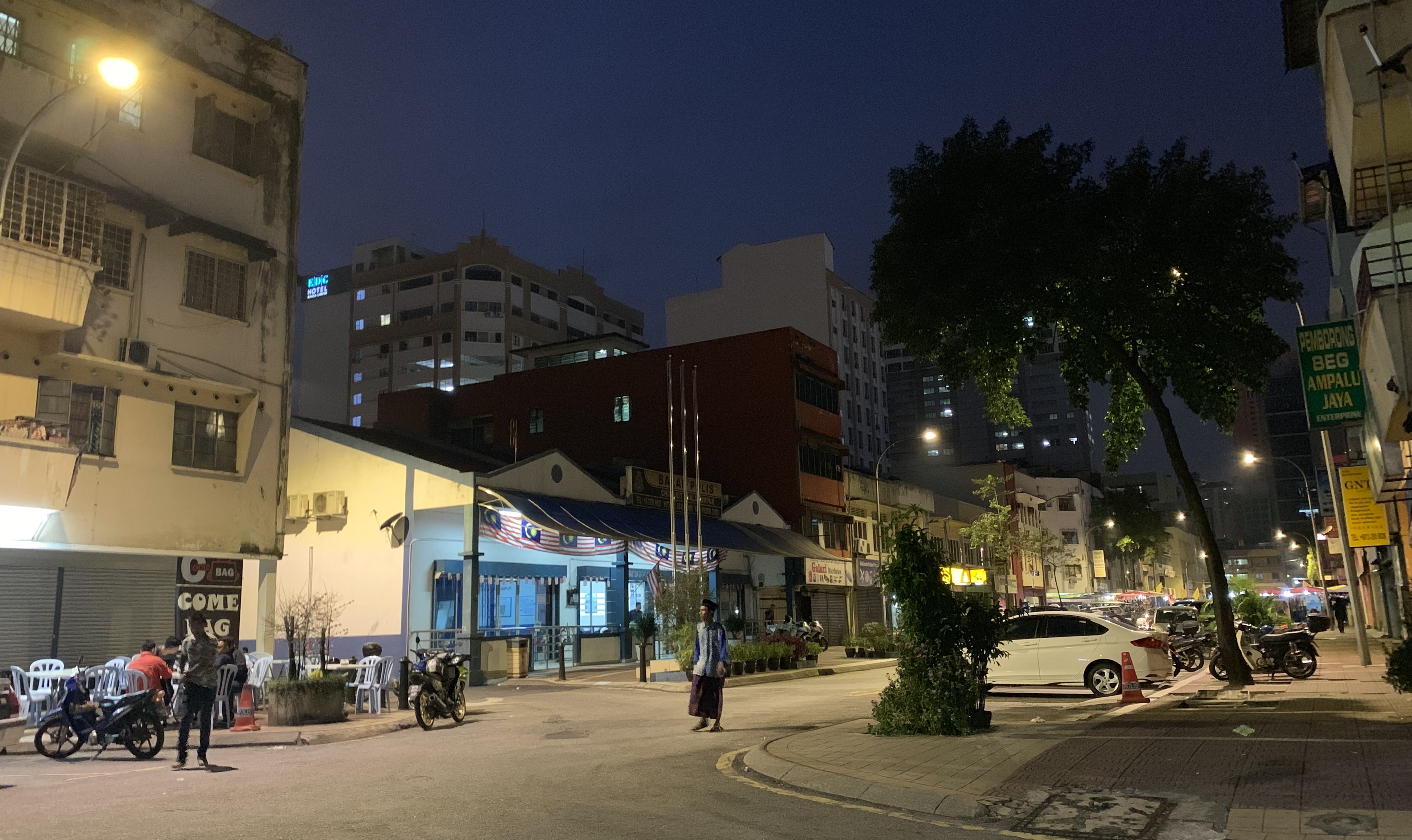
Dora and I walked through the quiet nighttime streets of Chow Kit, a downtown neighborhood in Kuala Lumpur. [1] [1] All names have been changed to protect people’s privacy. Pungent food smells mingled with the sweet scent of fruit and flowers from a nearby market. Abandoned rainbow-colored confetti shivering under the dim, yellowish streetlights reminded us of some celebration that took place earlier. [2] [2] The author’s research was carried out within the Emmy Noether Junior Research Group “The Bureaucratization of Islam and Its Socio-Legal Dimensions in Southeast Asia,” funded by the German Research Foundation (DFG) from 2016 to 2023. The writing of this essay was supported by the FERBOPO Research Project (Grant Agreement ID: 101184092).
In the 1970s and 1980s, Chow Kit was a bustling red-light district. Today only around 15 to 20 sex workers can be seen on any given night, according to Dora. The decline is due to a worsening economy and increased surveillance by Islamic authorities.
“Most hide from the religious police in these rundown buildings, hoping to find clients using apps,” she said. As we passed a police station, Dora explained that officers required bribes from each sex worker to allow them to work. A local mafioso further exploited them, demanding “protection money” while offering no real security.
Many of the sex workers are transgender women who moved to the city from rural areas at a young age to begin their transitioning journey. But employers in Malaysia often discriminate against trans people, leaving sex work as the only means of survival for some.
Dora was one of many trans women I met while living in Malaysia in 2018 to conduct anthropological fieldwork with the trans community and with Islamic authorities. Dora had never engaged in sex work, but as a trans woman and advocate, she was intimately familiar with the challenges faced by most of her trans “sisters.” While we sat at a streetside food stall and sipped on sweet teh tarik (hot milk tea), Dora reflected, “When you are in Chow Kit, you are nobody. That’s how people see you.”
In recent decades, Malaysia’s state and religious institutions, which jointly govern following conservative Islamic interpretations, have heavily invested in the “moral reform” of citizens labeled deviant. Trans people are criminalized under both sharia and civil law. Trans women can be arrested for “posing as woman” and subjected to jail, fines, or religious “counseling.” They are denied basic rights, excluded from certain jobs, and often humiliated or abused for their identities.
Starting in 2011, the central government’s Department of Islamic Development (JAKIM), which oversees the implementation of sharia law, has launched programs to “guide” LGBTQ+ Malay Muslims “back to the right path” (kembali ke pangkal jalan in Malay). Working with local state religious councils, universities, and Islamic non-governmental organizations, JAKIM issues training manuals, holds talks, and funds research promoting the idea that LGBTQ+ people can be “cured” through religious rehabilitation. It also organizes Mukhayyam, or Islamic camps, to “rehabilitate” transgender individuals. The trans women I met who had attended these rehabilitation camps and programs understood their true purpose: to convince them that living as trans was sinful.
During my fieldwork, I met trans people from all walks of life: activists, NGO workers, sex workers, beauticians, artists, hospitality workers, and corporate employees. Some struggled against state-imposed interpretations of Islam, which do not accept trans people. But many found a supportive community in Kuala Lumpur and embraced their lives as Muslim women. Their paths to self-acceptance were diverse and are ongoing.
THE “RIGHT” PATH
Many of the trans women I met in Kuala Lumpur shared they had felt a mismatch since childhood between their male bodies and female identities. Some trans women activists now in their late 40s or early 50s, such as Dora, first met through the PT Foundation, a pioneering organization founded in 1987 to support the LGBTQ+ community during the HIV/AIDS crisis. As global discourses on human rights and gender identity reached the region around the early 2000s, more transgender people in Malaysia began to “come out”—with a new language for articulating what they had long felt. The identity term “mak nyah,” coined by the community in the 1980s, has now been largely replaced in activist and policy circles with “trans women” (or trans wanita, a hybrid English-Malay term).
However, increased visibility and access to information have not led to greater legal protection or societal acceptance. Instead, conservative voices in Malaysia and neighboring countries have grown louder in advocating for the “correction” of trans individuals. Under this political climate, Mukhayyam camps and similar programs proliferated.
Held regularly at tourist locations to attract attendees, the Mukhayyam have strict daily schedules, including prayers, religious classes, health talks, and physical activities like jungle trekking intended to enhance “masculine features” among trans women. While publicly framed as vocational training and public health programs, these camps are based on unfounded, fabricated, and harmful claims, including stereotypes that most trans women are sex workers with HIV/AIDS who need saving.
Read more from the SAPIENS archives: “Stop Erasing Transgender Stories from History.”
Contrary to official claims about the success of Islamic “rehabilitation” for trans people, I never heard any trans women say the programs “corrected” their gender identity.
Some trans women I met who participated in a program similar to Mukhayyam, established by one of the State Islamic Religious Councils, joined seeking community, a weekend trip, or deeper Islamic understanding. But most were older, ill, or in need of zakat, the Islamic financial assistance the program offered. Typically, zakat is meant for all Muslims in need without any obligation in return, but trans participants can only receive this aid money—usually enough to cover monthly rent and food expenses—if they contractually commit to attending the program.
Malaysian state-sponsored authorities and their supporters deny their practices share similarities with other “conversion therapy” practices that claim to “cure” queer and trans people. These can involve exorcism, medication, confinement, electroshock therapy, behavioral conditioning, and verbal, physical, and sexual abuse. In 2020, JAKIM reported an LGBTQ+ activist to the police simply for comparing the rehabilitation camps to “Western” conversion therapy. However, several Malaysian NGOs and LGBTQ+ rights groups have spoken out against Mukhayyam and similar programs, presenting evidence that they do use violent, coercive techniques associated with other conversion therapies found globally.
Over the past several decades, human rights organizations such as Amnesty International and academic societies such as the American Psychological Association have denounced conversion therapy practices aimed at LGBTQ+ people as harmful and “amounting to torture” in some cases. While these practices are banned in some countries, such programs continue to receive support from national policy initiatives and religious organizations. Conversion therapy programs remain legal in most parts of the world and are on the rise again in increasingly conservative and authoritarian states, including in the United States.
NAVIGATING LIFE AS MALAY MUSLIM WOMEN
I met Ana, a devout Muslim and Dora’s acquaintance, in one of the state-sponsored “rehabilitation” programs. She initially joined for financial help and religious learning, but had grown disillusioned. Still, Ana remained in the program on and off for years, partly to receive zakat and partly to challenge the program’s agenda. She resisted the religious teacher’s efforts to make her conform to male rituals and appearances, and regularly challenged the anti-trans rhetoric of the program.
Some of Ana’s peers in the program compromised and changed their physical appearance to resemble a male person, although they claimed they were still women inside. JAKIM showcases these “repented” trans women as success stories. “Some don’t know who they are,” Ana told me.
I met other trans women who struggled more to find the self-acceptance Ana achieved. For example, I spoke with Zita, who was homeless and earned a living through sex work.
“How did it feel when you came out?” I asked.
“I felt relieved, like I didn’t have to pretend anymore,” she said. “But in the end, I’m still pretending.”
I could not hide my surprise. “Are you pretending?”
She sat quietly for a while before answering my question. “Yeah, in a way. I am pretending to God. Yes. Pretending to myself. Yes. That is hypocrisy,” Zita said in a shaky voice.
She believed that being trans was sinful, which is what most religious leaders preached. “Of course, this [being trans] is wrong. But what are we supposed to do? How are people like me supposed to survive? I cannot live like a man, that’s also hypocrisy,” Zita said.
Contrary to official claims, I never heard any trans women say the programs “corrected” their gender identity.
Others told me they had moved past this stage of self-questioning. Some identified with global communities of trans people and found self-acceptance after learning about different theories of gender identity and expression. Others, like Ana, tended to find human rights and scientific discourses around trans identities based in secular Euro-American traditions elitist.
Those who remained devout Muslims were often not comfortable praying in mosques because of the stigma they continued to experience from others. Still, many who did not practice the rituals continued to find comfort in their faith in Allah. Some also looked to more expansive readings of Islam, referring to the Quran’s original text and to interpretations by Islamic jurists who do not condemn transgender people.
Ana told me, “I know God created me like this for a reason, and I must honor that by living my life as a woman.”
TRANS LIVES MATTER EVERYWHERE
When I spoke to Ana, Dora, and other activists, I found their views diverged on how to respond to state-sanctioned transphobia, how a Malay Muslim trans woman should present and express herself, and what rights they should claim. Dora, for example, who had worked with NGOs, government, and Islamic organizations, told me she believed in “soft advocacy.” She felt that seeking tolerance for trans people, rather than acceptance, was the most realistic strategy.
Others, like Ana and Dora’s friend Mimi, advocated for legal gender recognition and equal treatment for trans people. “When you decide to come out, you put yourself in danger,” said Mimi. “But I want people to know who I am.” She expected people, including religious officers and public servants, to respect her chosen female name and pronouns. In 2011, she and other activists met with JAKIM to discuss the Mukhayyam’s objectives, but after failed attempts at dialogue, she gave up collaborating with religious authorities.
Regardless of these differences, Ana, Dora, and Mimi all believe God created them as they are and that being trans is not a sin. “No one can change us,” they agreed.
When government and religious authorities in Malaysia and elsewhere demonize trans people as a threat to the moral integrity of society, they are spreading fear through claims based on fabricated assumptions and misinformation. One often-underdiscussed aspect of this manipulative rhetoric is that it frames transgender identity as oppositional to spirituality and religion, and pushes the false narrative that all trans people are secular.
Trans people continue to experience discrimination and oppression worldwide, while they simply seek to be acknowledged, respected, and granted the right to live with dignity and peace. This involves allowing trans people to freely practice their religions without forcing them to change. The stories of my Malaysian trans women conversation partners illustrate that it is not only possible to be both trans and devout, but that deep religious faith can also be instrumental in fostering self-acceptance. The journeys presented are ones of resilience and hope for more inclusive societies in Malaysia and beyond.

Gréta Tímea Biró is a social anthropologist who received her Ph.D. from Friedrich-Alexander University of Erlangen–Nürnberg in 2024. Her research areas include gender and queer studies, the anthropology of international development (especially environmental issues), and anthropological approaches to state-sponsored (religious) rehabilitation and body politics, topics she has studied in Malaysia. Since November 2025, she has been a postdoctoral researcher in the European Research Area–funded Fostering Excellence in Research on State-Church-Body Politics (FERBOPO) project at Lucian Blaga University, Sibiu, where she anthropologically examines gender-based violence in Romania.
