









Five Questions for Anand Pandian
What keeps Americans apart—even when so much depends on coming together?
In this deeply personal and searching work, anthropologist Anand Pandian explores the invisible but powerful barriers that divide everyday life in the United States. From homes and highways to bodies and media, Pandian reveals how disconnection is built into the infrastructure of U.S. society—and how acts of care, curiosity, and collective effort can help us imagine life beyond the walls.
This 30-minute conversation is a profound reflection on how we might rebuild solidarity in a fractured world.
>> CHIP: Hello, welcome, I’m going to let the audience filter in here before we get started. It’s good to see you here. Thank you for joining us.
Hello and welcome, everyone, my name is Chip Colwell and I’m an anthropologist and the editorial director at SAPIENS and I’m here with doctor and professor Anand Pandian, is a Krieger-Eisenhower professor of anthropology at Hopkins University.
His books include a possible anthropology: Methods for uneasy times and accounts, a ledger of hope in modern India. He has served as president of the society for cultural anthropology, and ass a curator of the ecological design collective.
He lives in Baltimore, Maryland. Anand’s newest book which will be the focus of our conversation today has already received immense attention with essays, interviews and reviews in if guardian, USA TODAY and BBC money do. Thank you so much for being here, Anand thank you to the audience for being here.
One note before we jump in, if you do have questions for Anand we have the Q&A function at the bottom of your screen. Please use that as questions come to mind and I hope to leave enough time at the end for questions from you all.
But we’ll jump in with some of my questions first so first welcome Anand. It’s good to have you here.
>> ANAND: It’s good to join you here, I appreciate everything you folks have been doing to make more of a space for public engagement with anthropology.
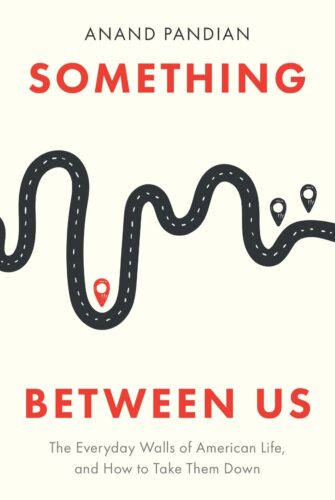
>> CHIP: And thanks for being a part of it. It’s really meaningful, Anand. I do want to congratulate you for your book, you newest book, something between us, the everyday walls of American life and how to take them down. It’s just been a remarkable success and I have a copy here behind me. I need to hold it up to literally celebrate it right here.
There you go. You can do it for me. So
… but, I read it. I love it. It’s so powerful. It’s so timely.
It’s so timely as an American, someone who sees what is happening in the country. There are just so many walls.
In American life today.
So many of these have been constructed really brick by brick over the years. When
and how exactly did this book come about?
>> ANAND: Yeah, it’s a really important question, thank you, Chip. It really had to do for me with the
way that 2016, the year 2016 unfolded. And the surprise of the presidential election that year. The sense that many people had that they couldn’t see this coming. The election of Donald Trump to the presidency of the United States.
And on the one hand, at a personal sense that this raised all kinds of questions for me about
my understanding of this country, where I was born and raised myself. The place of people like me. The place of people of color in this country. In the face of all of the xenophobic and hostile exclusionary rhetoric that surfaced throughout that campaign and continued thereafter even until this very moment in which we’re speaking but then also as an anthropologist trying to understand some of that passion in particular.
And it was the slogan build the wall. In particular. The passion with which people would chant that by the thousands. In arena after arena around the country. That was a really
deep enigma to me. What was it that led people to feel so deeply about that idea? Even if they lived so far from the border. The border region of that wall was promised to be built. And in many ways I set out as an anthropologist to travel around the United States, talk to people I didn’t know, people who had different positions in the world and different positions on our politics.
To try to unravel that question in particular.
>> CHIP: M-hm. And the book’s title, something between us,
hints at the
space between these walls or around these walls the things that divide us what did you find is that something. What is the something that is
driving society apart in the United States?
>> ANAND: It’s something between us at that moment was the headphone. That popped out of my ear. Forgive me for that. The book title comes from a phrase
from James Baldwin and a phrase that James Baldwin used in his famous debate with William F. Buckley in which he is speaking about the experience of being an African American outside the United States.
And his feeling that while white Americans who see him or saw him abroad would disavow any relationship they might have with him, any sense of kinship. There was something between them still. Baldwin insisted. Some underlying commonality. They are my countrymen Baldwin said in that conversation. And so
what I’m trying to get at in the book is that double sense that one can draw out of a phrase like that. That
on the one hand circumstances may be such that their surface barriers or obstacles between people that prevent the realization of any sense of commonality, but at the same time,
there is also an underlying kinship or relationship that draws those people together. And in thinking through the themes of that kind and in terms of the barriers in particular. As I began to think through the appeal of an idea like the border wall, and began to wrestle with that as an ethnographer by traveling around the country and meeting people in over a dozen states in different parts of the United States.
I began to see that ideas like the border wall appeal to many people because they resonate with the everyday walls and boundaries that so many people have come to live with and take for granted in their daily lives and so very, very quickly and simply the book travels through four dimensions of everyday walling off that I argue have come
to strand us in circumstances of great isolation and separation in the United States. They have to do with the walls of our homes. They have to do with the increasingly massive size of our automobiles and our road culture. They have to do with the way in which Americans have come to often to imagine their own bodies as
things that need to be armored off from the rest of the world and what I describe as walls of the mind in the book and the ways in which we seem to be locked so often into parallel universes. In terms of how we think and how we even understand
the underlying nature of reality so these are the different dimensions of what comes between us in our lives as Americans now that I argue in the back have a lot to do with the impasses we experience.
>> CHIP: M-hm. That’s really fascinating I think a follow up to that would be, so in the one sense of the something between us, the things that divide us are physical walls, ideological walls, social walls. In that other sense that you point to, what are the some things that actually
might bind a nation together? A community together?
>> ANAND: Yeah there’s a real paradox in terms of the quality of our lives as the quality of our social lives as Americans. And
we all are familiar with the idea of individualism. The extent to which the
American culture is grounded in the celebration of individual lives, individual capacities, individual trials of circumstance and so much of the inequalities, the deep and abiding inequalities that we see in the United States have to do with the fundamentally unlivable nature of the society composed of people
who imagine themselves solely as individuals. And who would concentrate so much of their attention and invest so many of their resources in securing their own well-being as opposed to that of others around them and, yet, precisely because of that deep and abiding inequality that is so much the fabric of American life
, those on the outside, those who are excluded, those who are marginalized by reasons of race or class or really any other form of social difference have by necessity had to work and
gather in a more sol dooristic sense and so the other side of the book that I’m also interested in and pay a lot of attention to are movements for environmental justice.
Racial justice, clean water, safe roads all of which approach collective life not in the interest of securing one’s own safety and security as an individual or as the member of an individual family or household but instead of broader terms of mutual aid and care taking.
That’s the other side of the story I tell in this book.
>> CHIP: I’d like to remind everyone about the Q&A feature at the bottom of your screen so please do offer your own questions so you can join the conversation.
Anand there’s so much I admire about this book. But one element that I have profound respect for is how you approach people with such empathy and curiosity. And
at the same time, you never hide your own viewpoints, you never surrender your own moral commitments. Can you share a bit about how you thought
around this question of, or the work of empathy or what I think we might even phrase as more of like a deeper complex empathy and not just a straightforward I feel you feel but you feel what someone else feels while not giving up your own sense of self in the world?
>> ANAND: It’s such an important question and such a difficult challenge I think people are asking questions about this very idea of empathy and with good reason. What do I owe people who deny my right to live? What do I owe people who deny the things, the very possibility of
taking seriously the things that I depend on in the things that I need? There’s so much institutionalized cruelty.
And indifference to suffering that runs through so much of what we see on a daily basis in this country and beyond in terms of the consequences of actions undertaken. By those in power in this country. The people ask, how sympathetic do I really need to be? And with regard to
the different stories I tell in the book and with regard to the different circumstances in the book, certainly, when I am thinking and talking with people, working to ensure forms of collective well-being, it resonates a little more with
the ideas that I hold dear. And the things that motivate my own work and maybe it’s a little easier to relate in the circumstances but as you know, having read the back there are a lot of places where I wind up.
Where it is difficult if not impossible to muster up that sense. There’s a whole chapter focused on ethnographic exposure to white nationalist rally in Tennessee. There was a chapter with arguments I had with a libertarian businessman in southern Michigan. There’s a lot of deep impasse and I don’t know that I can
say that it was always a sense of empathy or the kind of identification that we associate with empathy that I brought into all those circumstances. I certainly tried to approach them with compassion. And
with a willingness to understand as much as possible how people got to where they were. I would say in some ways, a lot of it to me has to do simply with a basic sense of curiosity.
How did we get here? How did you get here? This is really different than what I take seriously. What I think is necessary. What I take for granted as a decent way of being in the world. And yet, this feels meaningful to you. I want to understand that. I think that whatever care we wind up mustering up as anthropologists at some level does grow out of that sense of curiosity. About what is different from us.
And trying to understand what is different from us. From the inside out. Rather than from the outside in.
>> CHIP: M-hm. M-hm. Yeah, that really resonates and I think that is such a powerful form of engagement of when you see something different or
something you disagree with or something that feels initially beyond something you can conceive or even understand. Instead of pushing that at arm’s length you’re almost pulling that in and asking how did this come to be and I think that initial spark of curiosity is what we need a lot more of across a lot of different forms of engagement.
>> ANAND: And it’s hard. It’s hard when there’s so much violence and there’s so much suffering but the reality is that
we have to find some way of dealing with the deep investments in the difficulty. We have to deal with the investments in the suffering. The investments in the cruelty and unless we can find a way of grappling more effectively with those investments we’re going to remain at these impasses?
>> CHIP: Yeah. Again I’m speaking with Anand Pandian the author of the new book something between us, the walls of American life and how to take them down. You can get that book absolutely everywhere you get your book. It’s a highly successful book. In bookstores, online, please do, ask your local book sellers or wherever else you get books.
And you can easily find it. You share so many stories in this book, Anand, including some of your own but for here for this audience what would you like folks to know about your own story where you come from and how this shaped your work?
>> ANAND: Yeah, absolutely, thank you so much, Chip. I’m an Indian American the son of parents who emigrated to the States on the 1980s. I believe they may be on this call, so hello, to my mother and father I think they may be out there. This was the time when the United States was short on medical expertise.
And so there was a really a call for people to come and to meet that need which is how we got here and my brother and sister and I were all born here and we grew up in L.A. and we took for granted that we had a place here as so many other people do and I really do feel in particular that year in
2016 that these assumptions with were made about the place this country has for all of us. Positioned so diversely were called into question. And though as an anthropologist for most of my career I spent my life in sort of coming in and out of India and South India in particular. Rural India quite often.
It did feel to me like I should begin to take some of those skills that I developed and bring them back to this context that was more familiar. In part, in the, with the service of this kind of understand that we’ve been speaking about but also quite candidly because things happen to us as well. That were really difficult. Right? Moments when people in our own family were told to go back to their own country. Right?
Or called out on account of the color of their skin or on account of imaginations of what their religious faith might be. These are things that my own family, that we also went through and they really brought home for me the stakes of figuring out in a more personal and honestly more vulnerable way. What it might take to
get ourselves somewhere else electively.
>> CHIP: M-hm. We have some really beautiful questions lined up for you here Anand from the audience so let’s maybe turn to those now. The first question is, was there a topic or portion of your book that didn’t make to it the final publication? Would you focus on that topic for another book in the future?
>> ANAND: That’s a wonderful question. The structure of the book is… there’s a sort of crystalline nature to it. There are four sections, each section has three chapters and you might think, oh, what a need package. But the reality is that the research unfolded in a very improvisational sense. I was intuiting different openings.
And wound up going to places, spending time in places that I thought would be part of the story and wound up being not part of the story. So there are a lot of off cuts that remain on my mind. The one thing I will say though, thinking ahead, is that I imagine this book as part of a larger project of mine. A larger intellectual project of mine to try to make sense of what it means to really have an open mind.
We use this phrase, right? Keep an open mind, have an open mind. What exactly do we mean by that? How does one develop that capacity? What does it look like in practice and the closures that motivated the writing of this book have kept me thinking on that question and I think one direction this project will grow is in facing that other side more
squarely. Thinking back to what it would mean to cultivate the forms of openness that I try to model and pursue as a researcher moving through these situations in this book.
>> CHIP: Wonderful. The next question is, the way you talk about deeply understanding others while maintaining your own values and sense of self is incredible. How would you say doing the research for and writing this book changed you if it did?
>> ANAND: It’s a wonderful question. And the reality is that it took an enormous amount of personal growth on my part even to be able to write a book like this let alone research a book like this.
All of us know how easy it is to fall into arguments where rather than listening to what the other person is saying we’re basically just biding our time to get our word in, so get that rejoinder in, to say the thing that they’re not thinking about that they should be thinking about. And I’m an academic. I make arguments for a living.
And certainly that impulse to win the argument, to say the more effective thing, all these things run through my personal professional life in all kinds of ways that prove challenging with a project like this. Because the project is founded on
a willingness to listen and abide with things said that one might have the most visceral and deepest disagreements and unease with. So I did have to learn that.
Quite a lot. I would like to think, you can check with others who know me about whether this is true or not because you certainly shouldn’t take my word for it. I would like to think that I may have come out of this project with a little more patience. Than I had before.
>> CHIP: Do you believe any of these walls are fairly new developments in our society, American society or are they simply been exacerbated recently and how/why?
>> ANAND: There’s absolutely a historic idea. These depend on and build on long-standing histories of racial segregation the book begins and he understand in the city of Baltimore where I live which is in fact the city that pioneered residential segregation by race in the United States and I’m certainly paying attention to those dynamics in different parts of the book.
There’s an entire chapter that is located in a north Texas town and focuses on intergenerational struggles for desegregation and racial justice and thinks in the companies of folks doing that work so I’m thinking about those trajectories and thinking about these more recent developments it matters that our social media and our smart phones individuate our media consumption in a way that has never been the case until know.
It matters that the American automotive market is dominated by SUVs in a way that hasn’t been the indicates before. It matters what it feels like on the inside of one of these newer vehicles.
As opposed to what it feels like to walk outside of the vehicles. The transformations of the size of our homes, the layout of our neighborhoods, the securitization of the infrastructure. All of those things do have novel consequences but they build on those older history they take them in any directions just as those organizing against those developments now can learn from those older histories.
And those older trajectories of organize a movement of activism but also meet the needs of the present in different ways.
>> CHIP: M-hm. Thank you for those insights. And, yeah, the book is so layered, you know, I think bringing in those histories and you see the resonances of those histories even today. Let’s see if we can get to two more questions in the last five minutes here. The first one I will turn to is from an exceptional anthropologist and she thanks you for being here Anand.
And says I was wondering if you can speak to how early career anthropologists can think about our ethical responsibilities in the current moment and the critical labor that we may engage in keeping in mind the precarity of the academy, public scholarship funding and other challenges of these times.
>> ANAND: It’s such an important question. I have to admit that I was really conservative as an early career scholar. My first book was a much more conservative research monograph in terms of the kind of writing involved. In terms of the structure, of the argument, in terms of the kinds of things I try to say as the ultimate argumentative upshots of that work. It was really liberating for me.
It gave me in a personal way the freedom to take different kinds of risks that I think are reflected in the different things that I have written in the wake of THA
that privilege it is a privilege. It’s an unusual privilege and it’s one that we can count on less and less and so when I think about the challenges that folks of younger generations see in fields like hours when I think what about it means to be an early career scholar now I feel like it’s less about what I can advise to those folks.
And more about the institutional change that those of us with more seniority, those of us with more authority, those of us with more responsibility, what we can do to open up those parameters, those expectations, those structures, those conditions such that people can do more innovative, public facing, radical if we can use that word, experimental work from the get-go.
Rather than having to wait until something like tenure, if and when it comes to be able to take those risks. How can we collectively, those of us with the capacity to do so, move the discipline in a direction that shelters, that affords a little more shelter for those who are trying to do this kind of thinking and writing that’s the question on my mind.
>> CHIP: In the last few moments I will try to combine two questions because they’re so helpful how do you see a movement towards mutuality beginning in the U.S. but perhaps also beyond the U.S. because so many of these issues and the walls that divide us and the something between us goes beyond the U.S. as well.
>> CHIP: It’s such an important question. Luckily the answer doesn’t have to be abstract at all.
This book was a long journey in the making. It was a long journey in the making because as I said to Chip just before we started a little while ago it took me a while to find a publisher for this book. A lot of people turned me down. It was a little more timely than I expected and also took more time because of the pandemic which we all lived through in recent years and though that was a time of great difficulty.
It was one of those moments that we saw so much collective attention to the most vulnerable among us. So new strategies for in fact collective care taking that would address those conditions of
structural vulnerability we have these examples to build on and they’re not new they have been with us as long as we have had the United States. Because as long as we’ve had the United States we’ve had deeply structured and sedimented forms of vulnerability that people have had to find a way
of dealing with and so I think there’s an enormous amount to learn from the heritage of those struggles. That organizing and that thinking and that’s a lot of what I’m trying to do in this book as well to try to pick up and move forward what it is that
these movements have taught us with regard to our ways of being American.
>> CHIP: We are out of time but thank you so much Anand for joining us, carving out time to share your story with us, the audience and I wish you so much luck in spreading these stories even further.
>> ANAND: Well it really is such a privilege, Chip, and I’m so grateful to you and everyone at SAPIENS and Wenner-Gren for making these kinds of conversations possible. Thank you.
