






















When People—and Files—Talk Back to Bureaucracy
Enter the Reception Room, and you will see a mismatched jumble of old furniture washed by the dim blue emitting from fluorescent overhead lights. It’s unremarkable. But those who find themselves here know that what goes on in the room matters.
At the far end of the room, the receptionist sits at a large, imposing desk. She is the gatekeeper to the bureaucratic maze that lies beyond the time-worn glass doors of the Reception Room, ascertaining the merits and demerits of the different cases, facilitating and blocking access, directing the arriving public to the correct department, wing, block, floor, and person—or sending them away.
As anthropologists and ethnographic filmmakers interested in bureaucracy, we are observing this entry point into the main government body for subsidized housing and urban development in New Delhi, India. Residents of the capital city, past and present, collect here to inquire about public housing applications, request a change in land title, renew a lease, contest a land dispute, secure freehold over their land, address a grievance, submit additional paperwork, or chase after a promised compensation.
We observe people approach the reception desk, seeking clarity on the status of their disparate files. We ourselves await permission to film inside. Like others filling up this small room, we are overwhelmed by the sheer size and convoluted form of the system. None of us fully understand the processes or timelines, or what would be required to expedite matters: This is the tangled and sprawling nature of bureaucracy. Just when we think we understand something, we realize what has been grasped is but a minuscule part of a greater interstitial web whose larger shape remains elusive.
The illegibility and obscurity of bureaucracy can be the source of much confusion, helplessness, and exhaustion. Oftentimes, this leads to anger, even political disenchantment.
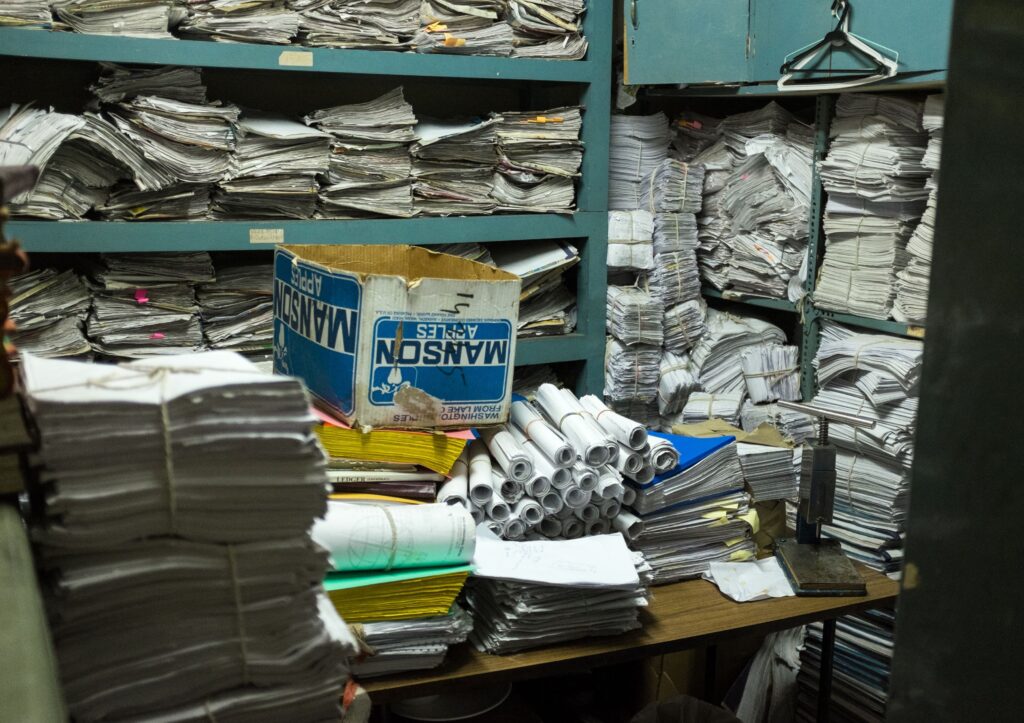
But this tedium and the relentless labor required to figure out the workings of the state also sparks imagination. Amid the prolonged waiting, everyone comes to fixate on the material representation of the claims they’re making to the state: “The File.” All kinds of speculative wonderings about this central bureaucratic artifact—where the file is, with whom, and how it can be moved—come to guide people’s speech and efforts.
In what follows, we offer glimpses into these observed bureaucratic encounters at the desk interrupted by fictionalized conjectures of where people’s files might be in the winding corridors of the bureaucratic interiors. Amid the many things beyond one’s control, these flights of imagination become a means of reconciling the uncertainties imposed by the forced waiting of bureaucracy. In between fact and fabulation, these scenes provide a break from bureaucracy’s humorless tedium. They also open up other possibilities—alternative encounters that both critique the otherwise inaccessible state and make moral claims on it to do the right thing.
SCENE 1
It is a slow Wednesday.
A middle-aged man stands at the receptionist’s desk, looking slightly discomposed.
Addressing the receptionist, he says, “Why have I come? I’ve been coming here every two or four months. Just to make a round. But nothing is moving forward.” He announces to the room that he had traveled very far.
The receptionist replies, pointing to the notice board listing the “public dealing” hours: “Monday, Tuesday, Thursday. Not today. Come tomorrow after 2:30 p.m.”
It’s late afternoon already. He can see that the receptionist will not be moved. Still he pleads, “At least advise me a little, so I have some assurance …”
With his desperation palpable, the receptionist allows him to continue.
“I filled the form to get a land allotment for housing and deposited 10,000 rupees. But I’m yet to receive any letter of confirmation.”
The receptionist shakes her head and says, “This year’s public housing list has not been released.”
“But my case is three years old, and the letter is yet to come?” he asks, puzzled.
“Why? Where have you been?” the receptionist retorts.
“Me? I regularly come here to make rounds. Every two to four months, I make a round,” he says defensively.
“But you should come at the right time then!” the reception responds.
Despite her admonishment, the receptionist seems more sympathetic now. She dials a number on the phone, pushes it toward him, and advises the man, “Talk on 1702.”
This is a first for him. In three years, he has never managed to get so far and speak to someone “inside.” Eagerly, he takes the receiver. A long, coiled cord trails out from the back of the telephone like a connective thread to the universe beyond the Reception Room.
“Hello?” he asks, awaiting a voice from the other end.
IMAGINATION 1
SCENE 2
It’s Monday morning. A voice booms out, “But the file had just been sitting there!”
The elegantly dressed woman’s anger is palpable as she yells toward the receptionist. The faces of others present turn curiously toward the high-decibel drama unfolding at the Reception Desk. The visitor stands, her crisp shopping mall bag swinging wildly as she emphatically gestures. “The officers keep saying, ‘Come today, don’t come tomorrow. Don’t come today and come tomorrow.’ What is one to do?!”
The receptionist tries to interject, but the woman is not finished. “I no longer live in Delhi! I have come here, leaving my child behind. I’ve made four rounds this month alone, and only now has the file progressed a little. The matter was stuck for a whole year—they said the file was lost!”
“Yes, yes, files can be like this …” the receptionist clucks, offering her understanding.
“No!” the woman claps back. “It’s all just cheating. What woman can leave her home and sit here all day?!”
“Madam, it would be better if you made this fuss inside,” the receptionist says. She’s trying to redirect the woman’s exertion of energy by reminding her the complaints can wait until she gets past the waiting room doors.
“Madam, you don’t think I did that? It is because of my noisemaking that the file missing for so long has at least now reappeared,” the woman retorts.
She looks momentarily triumphant about this little success she has wrestled out of the system, thanks to her noisemaking and round-making.
IMAGINATION 2
SCENE 3
It’s lunchtime on Thursday. While other members of the public are turned away and told to wait for the hour to finish, an older man is allowed in and offered a chair by the lunching officers who have collected in the Reception Room.
Amid the commotion of open lunch boxes and gossipy chatter, the man begins, “My wish is …”
He is a familiar face in the Reception Room. For years, he worked at the government agency. Now retired, he continues to visit the office for chai and nostalgic chitchat. Today, however, he has arrived in a different mood. His blocked pension is on his mind.
“My wish is for the file sitting in Dispatch to be moved forward,” he asserts.
“But did you tell him the entire story?” the receptionist asks, her mouth full.
“Yes … to Kamal … Kamal Singh … Kamal something. Well, the man who sits in the corner of D-310 …” the older man trails off, the details muddled.
“No, but did you talk to Diwan?” the receptionist presses. It’s not Kamal but Diwan who he needs to speak with. The lunching officers begin discussing different rules and procedures.
The older man feels himself being pulled into the weeds. Irritated, he directs attention to the big picture. “Let me tell you how the story is going to shape up,” he interrupts. “I speak from 40 years of experience. I’ll come on Thursday. And on Thursday, they will tell me, ‘He’s not in today.’ And even if he is in that day, on Thursday, they will tell me, ‘Sorry it has not been signed. You come again next Thursday or Monday—some other public dealing day.’ I want none of this, which is why I want the file sitting in the Dispatch department to be processed today.’”
The lunching officers nod. They seem to concede.
“It must!” The man doubles down, his fist in the air.
IMAGINATION 3
Taken cumulatively, one might initially read these scenes as a reflection of state bureaucratic red tape and incompetence. This critique of government as inefficient, wasteful, and even mind-numbingly “stupid” is often espoused by people across the political spectrum—from the right to the left.
But our time in the Reception Room draws attention to something else. Even in prolonged moments of waiting and in the face of seemingly arbitrary rules, people hold firm to their sense of moral entitlement in what they are owed. They remain confident in their rightful claims as citizens.
Their persistent actions, complaints, and demands recall an idea of the state that has faded in memory. This is a state that is not just a service provider but an institution that bears the responsibility of the public’s welfare. Such an understanding is particularly crucial now when politicians in many parts of the world triumphantly call for massive cuts in state funding in the name of reducing bureaucracy to promote “efficiency.”
The answer to bureaucracy’s failures cannot be found in inefficiency alone. As the Reception Room reveals, what animates people’s engagement with bureaucracy is not just frustration but also an understanding of the social contract between citizen and state.
Instead of fixating on efficiency, the state has a moral duty to care for the public.

Ikuno Naka is a research fellow at the Max Planck Institute for Social Anthropology in Germany, where her research grounds itself in the study of cultures of capitalism and its spatial expressions in ecology and the city. Her current research grounds itself in the coastal wetlands that have become the “emerging” city of Cochin in the South Indian state of Kerala, examining the landscapes of speculation that are re-shaping urban ecologies.

Garima Jaju is a Smuts research fellow at the Centre of South Asian Studies, University of Cambridge. An anthropologist of economic life, she is interested in questions of labor, money, and kinship, with a regional focus on India.
