

















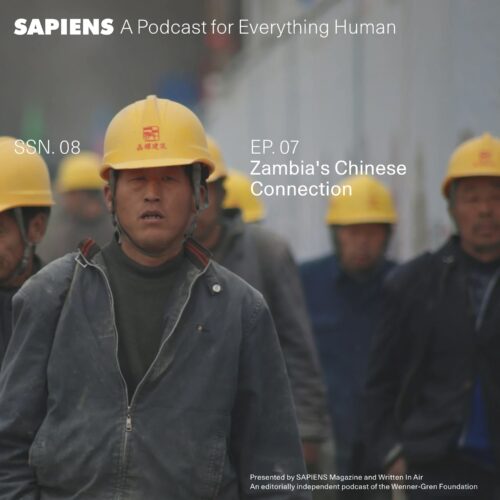


In the last two decades, an unprecedented wave of Chinese investment and migration to Africa has transformed many economies on the continent. But this has also provoked a storm of controversy, as some criticize the situation as exploitative neocolonialism. Others defend this migration as development assistance and an act of solidarity between regions jointly victimized by European colonialism.
In this episode, anthropologist Justin Lee Haruyama takes us to Zambia, where Chinese investment is bringing two cultures together in the country’s mines. Justin speaks with local Zambians and researchers on Chinese migration to examine the complicated impacts Chinese activity is having in Africa today.
Justin Lee Haruyama is a British Columbia–based writer, researcher, and anthropologist. He is a fellow with the American Council of Learned Societies and incoming assistant professor at the University of British Columbia, Okanagan. He received his Ph.D. from the University of California, Davis, and has received grants and fellowships from the National Science Foundation, U.S. Fulbright Program, and Wenner-Gren Foundation. Justin’s research examines the controversial presence of Chinese migrants and investors in Zambia today. His writing has appeared in The Chicago Tribune, The South China Morning Post, Anthropology News, Somatosphere, Cultural Anthropology, and elsewhere.
Check out these related resources:
- “Jehovah’s Witnesses Are Learning Chinese to Evangelize in Zambia”
- “Chinese Media Is Obsessed With Portraying China as Africa’s Savior”
- “Belts, Roads, and Non-Hegemonic Dreams”
- “Global China in Zambia: Labor, Capital, and Cultural Tensions”
- Affective Encounters: Everyday Life Among Chinese Migrants in Zambia by Di Wu
SAPIENS: A Podcast for Everything Human is produced by Written In Air. The executive producers are Dennis Funk and Chip Colwell. This season’s host is Eshe Lewis, who is also the director of the SAPIENS Public Scholars Training Fellowship program. Production and mix support are provided by Rebecca Nolan. Christine Weeber is the copy editor.
SAPIENS is an editorially independent magazine of the Wenner-Gren Foundation and the University of Chicago Press. SAPIENS: A Podcast for Everything Human is part of the American Anthropological Association Podcast Library.
This episode is part of the SAPIENS Public Scholars Training Fellowship program, which provides in-depth training for anthropologists in the craft of science communication and public scholarship, funded with the support of a three-year grant from the John Templeton Foundation.
Zambia’s Chinese Connection
Eshe Lewis: What makes us human?
Anahí Ruderman: Truly beautiful landscapes.
Nicole van Zyl: The roads that I used every day.
Thayer Hastings: Campus encampments.
T. Yejoo Kim: Eerie sounds in the sky.
Eshe: What makes us human?
Cecilia Padilla-Iglesias: Division of labor.
Charlotte Williams: Colonialism.
Giselle Figueroa de la Ossa: The value of gold.
Dozandri Mendoza: Fun. Dance.
Justin Lee Haruyama: Cultural and social interactions.
Luis Alfredo Briceño González: Hopes for a better future.
Eshe: Let’s find out! SAPIENS: A Podcast for Everything Human.
[INTRO ENDS]
Eshe Lewis: Over the last 20 years, Chinese investment and migration in Africa has transformed economies across the continent. But at the same time, these practices are provoking controversy as some criticize it as exploitative neocolonialism.
In this episode, I’m talking with anthropologist Justin Lee Haruyama. He’ll tell us how Chinese investment and migration is impacting Zambia, a country where two cultures are coming together in the nation’s mines.
Eshe: Hey, Justin.
Justin Lee Haruyama: Hey, how are you, Eshe?
Eshe: I’m good.
Justin: Awesome.
Eshe: Could you please introduce yourself?
Justin: Yes, my name is Justin Lee Haruyama. I am a fellow with the American Council of Learned Societies and also an incoming assistant professor at the University of British Columbia, Okanagan.
Eshe: Congratulations. So exciting.
Justin: Thank you.
Eshe: Can you tell me a bit about what you work on?
Justin: I do research on Chinese migration and investment to Zambia, and I study a multitude of cultural and social interactions that emerge from different kinds of Chinese operated work sites.
Eshe: So what’s going on there?
Justin: A lot of people probably don’t know much about China in Africa unless you’ve seen some news headlines. It’s not talked about as often, for example, as U.S.-China geopolitical rivalry. And that has a lot to do with the Western-centric nature of a lot of the media we consume, especially in North America.
But over the last two decades, Chinese migration and economic investment and infrastructural loans to countries throughout the African continent has been a huge phenomenon in African societies. And so just to give a few numbers: In the late 1990s, Chinese foreign direct investment in all of Africa stood at about US$56 million. And now it’s somewhere closer to like US$32 billion.
Eshe: Woah!
Justin: Yeah, a huge increase. And over the same period of time, the number of Chinese migrants in Zambia has increased sevenfold. There’s now Chinese investment and involvement in basically every sector of the Zambian economy: from mining to agriculture, manufacturing, small-scale trading, tourism. And this has created a lot of controversy. There have been various political campaigns that some have described as xenophobic against the Chinese. So there have been a lot of tensions, but also a lot of opportunities in regions that otherwise historically have received very little economic investment.
Eshe: So, Justin, what is your interest in this kind of research? How did you come to it?
Justin: I came to this research from a background in development studies. I lived for three years in different parts of Southern Africa and another six years in China. And I really wanted to study the way that Chinese economic investment and economic development and infrastructure loans are going to change African societies in the coming decades and century. And what kind of impacts this might have not only for elites in African capitals, but also for everyday people, especially in impoverished or rural regions of countries such as Zambia.
Eshe: So, you have spoken to a lot of people as you have conducted this research, and we’ll be hearing from a few of them in this episode. Can you tell me who we’ll be hearing from?
Justin: I’ll be playing two main voices that I talked to as part of this research.
One thing I want to point out for our listeners is that Zambia doesn’t always have well developed Wi-Fi technology, for example. And in fact, the Zambian mine safety officer, who I’ll introduce in a moment, we had this interview over WhatsApp, and he actually has to deal with, there’s a lot of what’s in Zambia called “load shedding,” which means, brownouts or power cuts. And so the audio quality is sometimes a little bit fuzzy.
Here’s the Zambian mine safety officer introducing himself.
Abel Mukombwe: My name is Abel Mukombwe. I am a safety officer for Collum Coal Mining Industries in Sinazongwe District of Southern Province in Zambia, Southern Africa. I’ve got 12 years experience in mining.
Justin: I also interviewed the anthropologist Dr. Di Wu.
Dr. Di Wu: So I did my Ph.D. in London School of Economics. For my research, I looked at Chinese state-sponsored projects. And also state-encouraged migration into African countries.
Eshe: OK, so we’ve got our characters, we’ve got you, and you have mentioned this when you were talking generally about your work and how you came to it, but can we circle back to talk about narratives, the kinds of things that we have seen or maybe haven’t seen in the news about this relationship between China and Africa? Maybe starting with, like, what is the dominant narrative?
Justin: The one major narrative that has emerged about China-Africa relations is this worry that China is coming in as an exploitative or even neocolonial actor in Africa. And definitely, in my research in Zambia, this is a big part of what I found; there is some significant accuracy in these kinds of assertions.
So, I’ll turn to the words here of the Zambian mine safety officer.
Abel: About Chinese in Zambia, they’ve come to maximize their profits at the expense of Zambians. They’ve come to pollute the environment. Their aim is just to finish our Zambian resources. So in general, I can say they are not good investors because most of the people who work for Chinese, they don’t appreciate them. They just work for them because they’ve got nothing else to do.
Justin: And specifically, this safety officer was very critical of his Chinese employers because he found that he was really trying to advocate for the safety of the workers at the mine, as he saw his role—he was employed as a safety officer—but he found himself continually stymied both by the Chinese owners of the mine as well as his Chinese colleagues among the management staff.
Eshe: Hmm.
Abel: The welfare of the workers, the Chinese, they don’t care. All they want is for the workers to be at the mine and to produce their coal. So to them, safety is an expense. If you say, for example, I need to buy the breathalyzers so that I ensure that there is zero alcohol at the mine. For the Chinese to buy a breathalyzer, for them, it’s an expense then that thing won’t be done.
Eshe: Well, yeah, I guess I can understand the concern because skimping on safety sounds really dangerous. Can you talk a bit about what some of the consequences of that attitude has been at the mine?
Justin: Yeah, the safety officer at this mine, he described this really tragic feeling he had when he tried to stand up for the safety of the workers. And, nevertheless, there were these mining accidents that sometimes would even kill a worker. And so here’s one story that he told me.
Abel: I used to go underground, inspect the area, check the area where the area is safe. So I found that there was an area which required support. It’s an underground mine. So, they have to do support as they are doing their development. So, I noticed one area which required to be supported. So, I went to a Chinese supervisor. So, I went to him and tell him that we need to do support there. And the Chinese said, “No, OK, OK. That area is still competent.” So, he was arguing with me that the area is competent, whereas the area was not, the ground was not competent.
Two days later, we had a fatality there. The rock fell off on one of the miners, and that’s how he died. When I informed the higher, the boss [of?] the Chinese, I was told to ensure that “in your report, don’t include that you told the Chinese. Just say it happened unknowingly.”
Justin: Here, even though he pointed out to his Chinese colleagues that the timber supports for this mine shaft were not competent. When they collapsed, he was pressured in order to keep that quiet and just say, “Oh, it was a complete accident. No, no one could have foreseen this.”
And these are the kinds of frustrations that he had in working at this mine for quite a number of years.
Eshe: Yeah, that sounds really scary and pretty bad overall. But I’m wondering if there are other perspectives on Chinese involvement in Africa.
Justin: Absolutely. So, even though this is a very important part of the story about some of these bad labor practices that do happen at some Chinese-operated labor sites, nevertheless, both Zambians and Chinese have also different ideas and different experiences about what this all means.
And Dr. Di Wu gives a really good reason for why we should engage in a more complex analysis.
Di: When we study China in Africa, I think there’s a tendency to see China as a homogeneous group. And also there’s a tendency to see Africans as a homogeneous group, as if they all do, when they interact, they’re all the same.
Justin: Also, what I found in my research is, actually, there’s a tremendous diversity of both Chinese migrant experiences and also of Zambian experiences that are really important to pay attention to.
Eshe: We’ll be right back with more from Justin after a short break.
[BREAK]
Eshe: Welcome back. Let’s rejoin my conversation with anthropologist Justin Lee Haruyama.
So, you know, we’ve heard from the Zambian side, but you also mentioned that there are groups of Chinese migrants who are now living and working in different parts of Africa. And I’m wondering how those different groups relate to larger projects, maybe neocolonial projects, as you said, of the Chinese state.
Justin: We need to break apart this idea of China as a monolithic actor. And while indeed, some parts of Chinese involvement in Africa might be directed by the Chinese state, actually, there’s a lot of Chinese people who are coming to Africa that are not invested in that, and here’s Di Wu describing some of those differences.
Di: You have Chinese officials and Chinese leaders, managers, they got sent to finish a project for the state. Their attention is very much back in China. So, to them, interacting with the local Zambians is less important than prioritizing the project itself in order to please their leaders back in China. On the other hand, you have the, we call it “peasants workers” in China, but they landed and started living in Zambia, because they went there to make a living, to survive and then to build a prosperous life in Zambia, so for them, the priority would be very different with the Chinese leaders. They’re more active in terms of trying to integrate into the local societies.
Eshe: OK, so this paints a picture of a heterogeneous group of people, right? Those who are, you know, very tied to their homeland. Other people who are more open to maybe making their life in Zambia. And speaking of Zambia, you’ve heard from a Zambian mine officer, and he has some very negative things to say about his Chinese employers. I’m wondering, other Zambians, what their perspectives are on these new relationships?
Justin: The Zambian mine safety officer had one very strong perspective about Chinese involvement in Zambia, but I met many other Zambians who had more rosy views of Chinese involvement.
Dr. Di Wu describes some of his experiences talking to older Zambians, who have memories of very positive Chinese engagement with Zambia in an earlier historical period, and then that causes them to reframe the way that they understand contemporary Chinese involvement.
So here’s an example that he gave in my conversations with him.
Di: So, the Zambian workers who experienced the Tanzania-Zambia Railway have families who worked for the project, the way they see Chinese activities in Zambia, and when they’re working for the Chinese companies, is very much based on understandings China is there to help them, just like how China has helped Zambians in the 1960s and ’70s. A good example was a cooperative farm with a dual manager system: i.e., the farm manager has one from the Chinese side and one from the Zambian side.
Justin: What Dr. Di Wu is referring to here is this history of an earlier period when Chinese companies were not investing in the Zambian mining sector, but rather when they were giving major development assistance to Zambia in a period when Western countries really weren’t willing to help out.
In the 1960s and 1970s, Zambia had developed majority rule for the African population. But it was completely surrounded on three sides by very hostile white minority regimes. These countries that surrounded Zambia on almost all sides at that time were creating this economic stranglehold on the country. At this really tense and difficult time for Zambia, Zambia turned to Western countries to try to ask them for help, because Zambia is a landlocked country, and it needed a transportation route to the ocean to export its mineral resources. And Western countries all turned Zambia down. But China came in and built the Tanzania-Zambia Railway, which was called the Friendship Railway at the time, connecting Zambia to the sea. And this was the economic lifeblood and allowed Zambia to continue its exports in a period when it wouldn’t otherwise be able to.
And so, the older generation among Zambians tend to have this rosier view of Chinese investment for this reason.
Eshe: Well, that makes a lot of sense. It’s funny, I think these things still happened within the lifetime of people who are a few decades older than us, and obviously that stays with them. And the memory of another country serving as an ally or offering some help can really do a lot to get people to continue to think favorably or to have high hopes for present or future collaborations.
But that said, that’s like one generation that’s older, but the median age in Zambia is only 18 years old. So, I’m really interested to know what the views of some of the people from the younger generation are.
Justin: Yeah, Zambia is quite a young country with a young population. And so this really important and really beneficial development assistance that came from China in the 1960s and 1970s is not so prevalent in their minds. And instead, they might experience, for example, as the Zambian mine safety officer did, exploitation at the mines as really continuous with older histories of colonialism.
And so here’s Dr. Di Wu talking again about some of his research with the younger generation in Zambia.
Di: For the young Zambians, especially the ones who were born in the 1990s, they didn’t even know China had aiding projects to Zambia back in the 1960s and ’70s. Their understanding and perceptions of China is situated in the current, after the 1990s globalization period of time. So the relationship is more, understand, according to how they experienced the British way of managing the labor. So, comparatively, for them, they see Chinese activities very much following what Americans and also the British was doing: i.e., purely economic and purely exploitative, even colonial. So, for them, it’s very much an exploitative working space.
Eshe: OK, so we’ve got some people with a positive view of these new relationships that are based upon past relationships that were helpful, we have the reality of exploitation and external political or financial pressures that have created an environment that has been, again, you know, exploitative and extractive. And I want to know, are there some positive interactions between Chinese actors and Zambians?
Justin: Of course, you have all of these migrants who are coming with the Chinese companies, and a lot of these workers are very working class back in China, or even what would be called “peasant workers” or mingong. These are workers that are looked down upon even within Chinese society and are coming to Zambia just to make a living. And so, of course, as they come to Zambia and they live there for several years or even longer, they develop all kinds of relationships with local Zambians, and some of those relationships can be quite friendly.
And so I’ll give a couple of examples, both from Dr. Di Wu and from Abel Mukombwe, the Zambian mine safety officer.
Di: One example was a guy who worked as a translator in a Chinese construction company. And then, I scheduled him to for a weekend sports event with the local Zambians. Frisbee in the park is one of the most popular games they were playing. So I played several times with frisbee. And also they tend to have a lunch or dinner with the local Zambians, and there’s no problem.
Then they starting to see the significance of friendship. Lots of times they went out for banquets, for these dinners, social dinners. And then they also invite their African business partners to China for tours. The local African business partners would invite them for their daughter’s weddings. This kind of informal way of networking really built a strong, kind of, convivial friendship.
Abel: I had one Chinese friend by the name of we were calling him Tao, he was a surveyor. That Chinese was very friendly. He can even come to my room, we chat with him. I go to his room, I chat with him.
Justin: So, even as sometimes these Chinese companies may not always be acting that well toward their workers, though this is a little complicated in a way I’ll mention later, nevertheless, the workers who work for these Chinese companies might be building up very friendly relations with local Zambians, as might also the small-scale private Chinese investors who are coming to Zambia.
Eshe: So, which of these stories about China and Africa—you know, the negative one about exploitation and neocolonialism, and the positive one about this internationalist development assistance and cooperation—which would you say is more accurate?
Justin: Well, I would say that they’re both accurate. In many regions of Zambia, for example, southern Zambia, which now has an expanding coal mining industry, otherwise, there were almost no sources of formal employment, and there was almost no economic investment coming to these areas. So, the influx of investment coming from Chinese companies has created all kinds of economic opportunities for local people that didn’t exist in that place before. But, of course, when those companies nevertheless are pushing the limit in terms of safety or not paying their workers as much as would be fair, that really limits the benefits that might be distributed in these communities.
So both of these narratives illustrate different facets of contemporary Chinese investments and involvement in Africa. Dr. Di Wu gives an encapsulation of this.
Di: There is lots of stereotypical discourses when people analyzing China-Africa relations from top-down perspective. That is, China is a neocolonial power, for example. Or you have the people to say China is actually the friends and really the support of the Third World Alliance. Both of these arguments are too simple to be true.
The real life, if you pay attention to how people on the ground understand their relationship, is much more complex. Only when you are paying to how local people, different types of experience and different types of understandings of and perceptions of China-Africa relations, we can see or speak to the story we tell about China-Africa more nuanced.
Eshe: OK, so I think on that topic of wanting a bit more nuance, I want to ask you, Justin, as someone who focuses on this intensely and has done a lot of work, what do you notice in terms of, I don’t know, what’s coming out of China-Africa interactions beyond these grand narratives that tell us that, you know, they’re good, or they’re terrible? What else do you see as being interesting that maybe people are not talking about?
Justin: Of course, I’ve also tried to look at what other kinds of things are Africans and Chinese migrants doing that are important to them, that are not always captured in political-economic debates that get played out in Western media. For example, Zambia is a deeply Christian country, and because many Chinese migrants are coming to Zambia without much background in religion, some groups of Zambians have developed a project of trying to reach out to Chinese migrants.
For example, entire congregations of Zambian Christians study Mandarin Chinese, all the way to becoming fluent. They will even hold their meetings exclusively in Mandarin from beginning to end.
Eshe: Wow!
Justin: Yeah! In addition to learning to speak Mandarin Chinese, they also develop an appreciation for Chinese culture and Chinese history and really seek out friendships with Chinese people.
I also examine the ways that new family connections are being formed. There are long histories of polygyny in both China and Zambia. So this is widely culturally accepted in both China and Zambia. Many Chinese men who migrate to Zambia have a wife and children back in China, but then they will also take up a long-term relationship with a Zambian woman and often have children. Again, because of the cultural acceptability of polygyny, often the Zambian wife and the Chinese wife will be in contact with each other, and so it’s an emerging family connection across continents.
One other aspect of my research are literally new languages that are being formed. Many Chinese migrants who come to Zambia don’t have proficiency in English or any other Zambian language. And many Chinese companies that do business in Zambia will hire only a few or even none at all translators or interpreters. So, on an everyday basis, Chinese and Zambians, they need to figure out how to communicate in the absence of a shared language. And so they literally create a new language that mixes English vocabulary with Chinese grammar.
Eshe: Oh, how interesting. It’s so fascinating to see what happens when people come together and have to figure out how to live together and what works and what doesn’t.
Well, Justin, I’m certainly glad that I have had the opportunity to talk to you about this. You’ve given me so much to think about. And I think everyone should be very glad that you are leading policy talks about mining, ’cause you do it so well. Thank you so much for talking to me today.
Justin: Thank you, Eshe. It’s been a pleasure.
Eshe: Justin Lee Haruyama is a writer and anthropologist based in British Columbia, Canada. His research examines the controversial presence of Chinese migrants and investors in Zambia today.
SAPIENS is hosted by me, Eshe Lewis. The show is a Written In Air production. Dennis Funk is our program teacher and editor. Mixing and sound design are provided by Dennis Funk and Rebecca Nolan. Christine Weeber is our copy editor. Our executive producers are Dennis Funk and Chip Colwell. This episode is part of the SAPIENS Public Scholars Training Fellowship program, which provides in-depth training for anthropologists in the craft of science communication and public scholarship, and is funded by the John Templeton Foundation.
