

















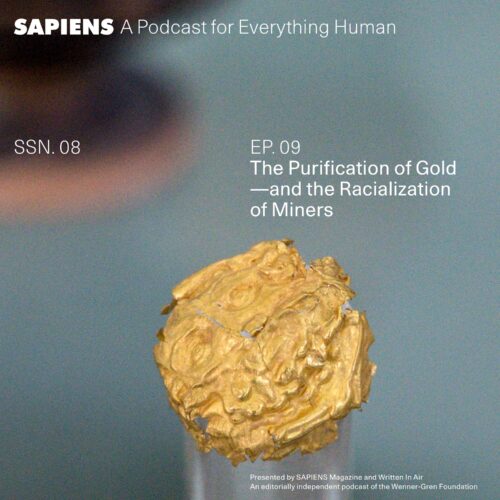


The gold industry, alongside nation-states, has marginalized the artisanal and small-scale mining (ASM) sector for decades, but now things seem to be changing. The industry has realized that engaging with the ASM sector could be more beneficial for their reputation than excluding it. While once ASM was viewed as a risk, now it is seen as an opportunity.
Anthropologist Giselle Figueroa de la Ossa spent more than 20 months studying the gold value chain and the actors involved in it. In this episode, she explores this recent shift around ASM and its unintended consequences.
Giselle Figueroa de la Ossa is a Colombian anthropologist and a Ph.D. candidate in anthropology at the London School of Economics. Her research explores the labor, ethics, and affects that make gold a valuable substance demanded by the tonnes. She draws from her multifaceted ethnographic research among bureaucrats, technocrats, and entrepreneurs who work on a gold mineral traceability project in Colombia and financiers who work on responsible gold sourcing in London, Switzerland, and Paris. She is the founding director of the Laboratorio de Antropología Abierta (Open Anthropology Lab), an organization in Colombia that, since 2018, produces audiovisual content for nonacademic audiences to increase the impact of academic research.
Check out these related resources:
- “La codicia detrás del comercio internacional del oro” (“The Greed Behind the International Gold Trade”)
- OECD Due Diligence Guidance
- London Bullion Market Association
- World Gold Council
- Alliance for Responsible Mining
- Open Anthropology Lab
SAPIENS: A Podcast for Everything Human is produced by Written In Air. The executive producers are Dennis Funk and Chip Colwell. This season’s host is Eshe Lewis, who is also the director of the SAPIENS Public Scholars Training Fellowship program. Production and mix support are provided by Rebecca Nolan. Christine Weeber is the copy editor.
SAPIENS is an editorially independent magazine of the Wenner-Gren Foundation and the University of Chicago Press. SAPIENS: A Podcast for Everything Human is part of the American Anthropological Association Podcast Library.
This episode is part of the SAPIENS Public Scholars Training Fellowship program, which provides in-depth training for anthropologists in the craft of science communication and public scholarship, funded with the support of a three-year grant from the John Templeton Foundation.
The Purification of Gold—and the Racialization of Miners
Eshe Lewis: What makes us human?
Anahí Ruderman: Truly beautiful landscapes.
Nicole van Zyl: The roads that I used every day.
Thayer Hastings: Campus encampments.
T. Yejoo Kim: Eerie sounds in the sky.
Eshe: What makes us human?
Cecilia Padilla-Iglesias: Division of labor.
Charlotte Williams: Colonialism.
Giselle Figueroa de la Ossa: The value of gold.
Dozandri Mendoza: Fun. Dance.
Justin Lee Haruyama: Cultural and social interactions.
Luis Alfredo Briceño González: Hopes for a better future.
Eshe: Let’s find out! SAPIENS: A Podcast for Everything Human.
[INTRO ENDS]
Eshe Lewis: If there’s one thing we can be sure of, it’s that gold is valuable. But why is investing and accumulating this precious metal perceived as prestigious when extracting gold is seen as greedy? And why do conflicts surrounding mining never seem to impact gold’s price?
To help answer these questions, I’m speaking with Giselle Figueroa de la Ossa, a Colombian anthropologist who studies the value chain of gold.
Eshe: Hi, Giselle.
Giselle Figueroa de la Ossa: Hi, Eshe.
Eshe: Can you please introduce yourself?
Giselle: Sure. Um, I’m a Colombian anthropologist and a Ph.D. candidate in anthropology at the London School of Economics. I study the social relations, narratives, discourses, and valuation practices that make gold a valuable substance demanded by the tons.
Eshe: OK, well, I have heard a lot of rumbling in the news about, you know, the price of gold being so high these days. Is there any chance that you know what the price of gold is today?
Giselle: Well, gold has hit a record high of $3,500 per ounce in April 2025. And just since Trump took office last January, the price has increased 30 percent because investors consider gold to be a safe haven amid economic uncertainty.
Eshe: So I’m imagining that people who are part of the gold industry must be really excited about that.
Giselle: Well, yeah, you can say that. The price is soaring, but paradoxically, the legitimacy of the value of gold and the legitimacy of the entire industry is being threatened all the time.
Eshe: OK, so what, what is threatening gold’s value?
Giselle: Well, basically all the conflicts surrounding gold mining and trade. I mean, anthropologists have been very good at showing us all the socio-environmental conflicts surrounding gold mining and large-scale mining companies’ impacts on the ground. But we can also talk about criminal mining because gold is so valuable in the field that criminals get a lot of profit from it.
And, gold, it’s also used for money laundering and of course, a lot of environmental issues like mercury pollution and deforestation. And there’s a whole issue on informalized artisanal and small-scale mining —ASM. And, so, yeah, there’s a lot of conflict surrounding gold, and all these unbridled extraction is motivated constantly by these rising prices.
Eshe: So if there’s all this chaos around gold mining, then why is it that the price never seems to be negatively affected by that?
Giselle: That was exactly one of my research questions for my doctoral project. How does gold bullion is valued in the financial market, you know, as a solid, safe, and riskless resource, while during its extraction and circulation, these processes are highly unstable, fluid, and risky.
So, I decided to study, you know, the people, the organizations, and their initiatives along the value chain that make gold an ethical substance.
Eshe: So, how did you get interested in this topic?
Giselle: Well, I became interested in social-environmental conflicts in a mining town in Colombia, but it struck me that miners didn’t know where the gold they were extracting was going to, let alone what gold was for. So, when I began my fieldwork in the other side of the value chain, I realized that these people at the other side—investors, refineries, luxury brands—they didn’t know where gold was coming from.
Eshe: Can you tell me what is risky about gold mining?
Giselle: Well, everything is very life-threatening. They have to use very toxic substances, for example, like mercury and cyanide. If they work in tunnels, they always are facing this risk of the tunnel collapsing over them. And so, they get killed all the time. And then the trade is also risky because gold is such a valuable substance that everyone wants it, so they cannot freely carry it. And, of course, the environmental risks as well, right? For the Earth that’s being toxicated also.
Eshe: Yeah, yeah, that’s alarming, right? OK, so we’ve got a really risky environment around extracting gold, very dangerous for the individual people, dangerous for the environment. Why is it that investors and refiners, and again, these luxury brands that sell us this very seductive image of gold and stability of gold, why is it that they don’t know about this origin? Or is it that they would rather not know, and they’re avoiding the knowledge because they don’t want to know?
Giselle: I would say it is related to the material properties of gold because artisanal miners are just bringing, you know, a little bit of gold dust, and it’s getting melted along with other sources. And, and that’s the process, right? That’s what I say. It’s fluid. It’s unstable. So, it’s really almost impossible to know the origin of specific amounts of gold. So investors, refineries, luxury brands, and the market participants, they were largely avoiding the origin question. Until 2010, the LBMA, which is the London Bullion Market Association, the Precious Metals Market Authority, they were only concerned about the physical purity of gold because that’s what you can guarantee, right?
Eshe: Yeah.
Giselle: You can analyze, you know, the physical purity, the geochemical properties of gold. And that was their main task. But in 2010, something happened which really changed everything. And it was that a member of the U.N. group of experts on the Congo made the industry aware that gold trade was fueling war in Congo. And knowing the provenance of gold became really, really relevant because the industry felt that their reputation was being threatened.
This is how Ruth Crowell, LBMA’s CEO introduced Gregory Mthembu-Salter at the Global Precious Metals Conference in Barcelona in 2023.
Ruth Crowell: I always think of Greg as my, my first date to responsible sourcing, where he came and spoke in Berlin. He came, he yelled at us, and he left. So we’ve invited him back to also bring to our attention what we should be focusing on. But hopefully in a slightly kinder but still very direct way.
Gregory Mthembu-Salter: People have different memories of it. I thought I was eminently reasonable, but it certainly wasn’t in line with what you normally get at that, at that time with the conference. Because I hadn’t been to one of these before, and most of the presentations to me seem to be about purity. The journalist came up and interviewed me afterward and wrote about it as part of their coverage of it, and I think that showed Ruth, or reaffirmed to Ruth, that this was something that was going to have to be tackled proactively.
Giselle: As Ruth said, Gregory is a member of the U.N. group of experts that made the gold industry aware of the relationship between gold trade and conflict financing. He’s a key person in the story because in 2010, he participated in the drafting of the OECD due diligence guidance, which was the first intergovernmental initiative to promote responsible supply chains to source minerals from areas of the world that were deemed to be risky and vulnerable to conflict.
And, now, almost 15 years later, Gregory is advising the LBMA on their strategy on ASM, and I interviewed him to get a firsthand account of this nearly 15 year-old story that is arguably sustaining the idea that gold is good.
So let’s listen to how he recalls that event in Berlin and how the responsible sourcing narrative has developed over the years.
Gregory: I said, you know, I’m gonna talk about what I know about, which is how gold is financing conflict actors in East Congo and where it’s going next and to bring to their attention that, you know, the U.N. Security Council has called on companies to do their due diligence.
Giselle: OK, so, in 2010, as you heard the U.N., the OECD, which is the Organization for Economic Cooperation and Development, also known as the Club of Rich Countries, and industry members got together to draft this guidance.
So Gregory told me that back in the days, the U.N. group of experts had suggested that companies should do due diligence, and they expected that everyone would understand what due diligence was. So let’s listen to how he explains the concept of due diligence and the purpose of the guidance itself.
Gregory: I always thought it was ridiculous that we had to define it. Any company that’s about to do business with another company knows exactly what due diligence is. You’ve got to find out what it is you need to know in order to do business with that person with a clean conscience.
So, the OECD guidance was to say, right, we are mitigating the risk of conflict financing. And then a few other things were thrown in. Worse forms of child labor was thrown in. Then an annex came in on corruption. But initially it was mitigating conflict financing risk. And it was like, it was to sort of define the playing field and say, look, companies, do this. NGOs, check that they’re doing that.
But of course, everything develops a life of its own that’s way beyond what things are originally conceived for.
Eshe: OK, so what was the outcome of that initiative for responsible sourcing?
Giselle: So, industry associations adapted rather than adopted the guidance, as academic Gavin Hilson once said. So the guidance was meant to prevent companies from causing harm to communities, right? But companies constructed communities as risk objects that were threatening their reputation, so the guidance was built with a risk language, like risk mitigation, risk management, this kind of language that enabled companies to turn the logics upside down.
So ASM was constructed then as a risky, and dirty, source that could contaminate the value chain. And actually the term “dirty gold” is very popular nowadays, like you hear it all the time in these conferences and documents that are circulating. And I see a racialization process going on here as well. ASM has been racialized even by industry critics, which now portray them as people that I need that are inherently messy and risky, and bringing so much, you know, trouble to the industry.
So, of course, Gregory says the true intention of the guidance wasn’t to motivate disengagement and the exclusion and marginalization of these actors, but to promote, what he says is progressive improvement, right? Like, that the companies would constantly work alongside miners to help them improve their practices rather than just exclude them from the supply chain.
Eshe: Yeah, so it sounds like the intention was to point out where risk could exist within the supply chain and to try to, as you were saying, mitigate that. But what it did was demonize people who are bearing the brunt of the work of extraction and people who are involved in smaller-scale mining. And that combined with, you know, racialization, you know, like, these are people who might be poor, these are people who might be Browner or Blacker, and then making them the problem, like, these are the people who are creating these habits that are dangerous, and they are the ones who are producing dirty gold. And also presenting a risk to these companies, and companies saying, you know, you are the risk, you are the problem, as opposed to looking at the entire chain and the entire ecosystem and saying that there are certain issues. So this seems like it’s like a bad fallout, like backlash, right?
Giselle: Yeah. Yeah, definitely. And what’s interesting is that Gregory himself, he’s pretty aware now of the unintended consequences of his work. So let’s hear how he describes this in his own words.
Gregory: This element that we tried to get into the due diligence guidance of progressive improvement had got completely squeezed by being translated into the language of compliance. And this is like a fundamental thing, which we, I confess didn’t think properly about what happens to complex narratives to do with assessments of contingent situations when they get turned into a compliance tool, because we didn’t know enough about auditors and compliance officials and it’s not pretty you know, especially when there was a nice secondary market sitting there in Dubai, where apparently you could buy as much as you like. And you did. So it was an elegant solution. And so, of course, the declared purchases of ASM just went down and down, down, down, down, until the point where it was heading more or less to zero.
We never thought when we did this guidance that, you know, Peruvian artisanals would be shut out of supplying the good delivery list. That was not on our bingo card kind of thing. So, there were lots of unintended consequences. Yeah.
Eshe: So the effect was that the situation for artisanal miners is getting worse in terms of, you know, the way that people think about what they produce. But, artisanal miners, I’m assuming, are still extracting gold, and so I want to know where this gold is going? Who is buying this gold if, if it’s still there, but not as desirable by, you know, luxury brands or people who will end up selling refined gold?
Giselle: Oh my gosh, we could do an entire episode on this. It’s huge. There is a huge controversy around recycled gold, right now. So Dubai is in the eye of the storm right now. And, but also non-Western countries like India and Turkey are buying gold without asking much questions about its origin, so around 10 years ago, roughly, brands, but also refineries and intermediate actors were using this idea of recycled gold to brand gold as green and, you know, being, good for the environment. But what is really happening is that gold gets refined in these places, and then it is sold to, for example, Swiss refineries, as recycled.
So, it is not actually recycled gold but laundered gold. So, gold that is coming from, you know, shady places or not even shady, like from legitimate ASM that have been cut off from supplying the mainstream value chain.
Eshe: We’ll be back with more from Giselle after a quick break.
Eshe: Welcome back. Before the break I was speaking with Colombian anthropologist Giselle Figueroa de la Ossa about artisanal and small-scale gold miners.
Picking up our conversation, I asked Giselle if the gold industry has realized that engaging with this ASM sector could be more beneficial for their reputation?
Giselle: So the legitimacy of gold, as I said in the first part of this episode, is being continuously threatened. So there is like this, you know, recycled scandal, which is the most recent one. But before, we got the 2008 financial crisis as well, which is pressuring financial markets to behave more ethically. Um, and then you have the rise of responsible investments like ESG, for example, which stands for environmental, social, and governance issues, which is arguably crashing now, but it’s still quite relevant. And so there is an increasing demand for ethical assets, right? In the financial world, and the industry is starting to see ASM as an opportunity to seize this trend.
So let’s hear how Gregory explains this link between scandals and the rising demand for responsible gold.
Gregory: There were some scandals. There have been scandals, and individual refiners have got burned. And you know, they often say to us, once the name of our refinery comes up with a scandal next to it, every time anyone does an internet search, that’s what they’re going to see. And this is not worth it for us.
Why would we do that? And then they talk about, you know, our banks. They’re so risk averse. And they say they’ve got to comply with their banking rules. And so there’s so many reasons to say no to artisanal miners. It’s as I said, and also because that gold turns up in the secondary market anyway, and it finds its way ultimately into the good delivery list, you know, but that but they’re also aware that doesn’t look great either, and that it would be better to be openly sourcing la creme de la creme of the ASM supply, which they can sort of put up their hands and say, yeah, we’re proudly sourcing that stuff. And there is growing demand for that. The luxury goods industry, it seems, in Switzerland, a thing of proudly artisanal responsibly sourced gold is a thing. You know, that’s a better story to tell than, yeah, that came out of this industrial mine, and it was ripped from the bowels of the Earth by some monster crusher machines.
Giselle: Yeah. So basically the industry wants to integrate ASM now as part of this emerging narrative around sustainable development.
So listen, for example, how Ruth Crowell, LBMA CEO, explains this shift at the Sustainability and Responsible Sourcing Summit in London in 2022.
Ruth: The other aspect is artisanal mining or a good-delivery list for artisanal miners. How do we take artisanal mining mainstream and create a halo effect for investors who are sourcing? Because certainly when it comes to ESG and society, the “S” in ESG has got to be the 40 million artisanal miners who depend on ASM for their livelihood and survival. And it’s something that if we’re going to make a real difference on these issues, we have to address.
Giselle: So this figure of the 40 million livelihoods has become central to the mainstream discourse. So you hear it everywhere, you know, in reports and conferences of the World Bank, NGOs. So social responsibility and local economic development, it’s like a big issue now for the industry.
For example, they said that ASM employs much more people than large-scale mining companies, because of course, large-scale mining is less labor intensive, and it’s much more mechanized. And importantly, the market is also seizing a sustainability discourse to make gold an attractive and legitimate asset for the 21st century. They talk about the environmental benefits of the gold market and gold extraction. For example, the World Gold Council, which is the association for the biggest gold mining companies, launched a report on gold and climate change a couple of years ago.
So let’s listen to how John Mulligan, the World Gold Council sustainability director, explains this strategy at the same conference in 2022.
John Mulligan: We started looking at climate change, as I say, about four or five years ago, maybe a little longer, and that’s because one of our core mandates is this idea of mainstreaming gold: making gold fit the purpose as an investment asset in particular in the 21st century. And some of the major institutional investors we were engaged with, they said, before you start talking about that research, what can you tell us about climate change? So we looked around the world and wondered where the facts were. You get a whole raft of indicators, which broadly suggest that gold as an investment asset can contribute to the decarbonization of portfolios. So from an investment point of view, it starts to become an opportunity for gold. And many of you will have heard of gold’s traditional roles as a risk mitigation asset.
Well, we’re starting to say that this data suggests gold can move toward being a climate risk mitigation asset.
Eshe: Yeah, I’m so confused. I mean, I’m really interested in the mental and technical gymnastics involved in getting people to believe that gold mining is, you know, going to help stop climate change, is good for the environment.
Can you walk me through how this is like a possible train of thought?
Giselle: Yeah. Well, basically, what he’s arguing is that gold’s carbon emissions are mainly concentrated in the extraction phase, right? So in mining sites. So when you decarbonize gold mining by shifting your energy sources from fossil fuels to renewable energy, then you are basically decarbonizing gold as a product and eventually gold as an investment asset.
So, then you can argue that you can invest in gold and that will be contributing to decarbonizing your portfolio.
Eshe: So, it sounds like what I believe the kids might call “a reach” because I would be pulling a muscle trying to reach my way into this argument, but, I guess they made it there. They’re a lot more flexible than I am, I guess.
Giselle: Yeah, so this, this recent shift in the narrative is quite a cunning move, because it is a narrative that, as you said, cannot be easily rejected by critics, and in fact, ironically, perhaps, it’s being supported by them.
So let’s hear from Greg himself, why he thinks the ASM sector is so important and valuable, which is aligned with the industry narrative, right? For 15 years, Greg has been a critic of the industry behavior, but now, well, he’s working with them, and I think they have kind of found a way in which they could work together because they are talking about the same things right now. Like the value of artisanal miners, the value of sustainable development in all this.
So yeah, let’s hear from him.
Gregory: So it is incredible to me that when the world agrees on almost nothing, but nearly all the world seems to agree that gold’s really valuable. I think that is valuable, in a broken world where poverty and cruelty are way too prevalent and malevolent political forces are on the rise, having a commodity that is directly accessible by the poorest of the poor, which has a possibility of reaching formal markets that in other ways would be completely inaccessible to these communities is something. That’s where my commitment is coming from. I’ve kind of been in this arena, and I’m unhappy with some of the unintended consequences of the previous work that I was involved in, and I want to do something to redress that.
Eshe: Um, I mean, do you agree with Gregory?
Giselle: I do, yeah. I do think that gold has the potential to work in ASM’s favor, of course, and in postcolonial nations’ favor as well. But what seems wrong to me is to keep thinking that this potential depends on ASM getting access to the mainstream market. For me, this reinforces the hierarchical structure of the value chain in which ASM is only valuable if they get access to the mainstream market, if they get validated by the mainstream market, right? So, and so ASM gold can only be valuable, and let’s say like “less dirty,” when it is accepted by white Global North men, right? And that, I definitely don’t, don’t agree with that.
And crucially, responsible sourcing not only consists in sourcing gold that doesn’t contribute to conflict, but also in sourcing ethical value from people further down the chain. I mean, in the first place, the industry is sourcing ethical value from the idea of ASM as being poor, underdeveloped, and in need, but they are also sourcing ethical value from, you know, academics, NGOs, and, you know, people, promulgating this narrative of sustainable development.
For example, in a panel at that same conference, called “Growing Demand for Responsible ASM,” they brought an academic and two NGOs to share their experience on the ASM sector. And they all supported the narrative that ASM wasn’t a mining issue but a development issue.
Eshe: So, would you say that the LBMA is also sourcing ethical value from Gregory as well?
Giselle: Yeah, in a way, because intentionally or unintentionally, perhaps, he has built his public persona around the fact that he has made the industry aware of the supply chain contamination. And he’s, I mean, he’s kind of a moral beacon to the industry, right? The industry respects him, and he often tells them what he thinks in a very direct way,
Eshe: Yeah, it seems like he’s a very critical person. I don’t know. Is he aware that there might be some unintended consequences of the work he’s doing now for the industry? Like does he have any thoughts on what the fallout could be?
Giselle: Yes, I asked him exactly that question, and this is what he said.
Gregory: It’s not very, this isn’t, we’re not trade unionists, this isn’t very class-based, that we haven’t gone as the association of artisanals and gone from the ground up. It’s been a leap down, down, down, down, down, down.
So the possibilities to leave fundamental worker conditions untouched is right there. I pushed it in our guidance that fair remuneration be part in the guide to the toolkit and immediately hit some roadblocks and find they say, “Oh, you know, what do you mean by that? We pay the minimum, you know, we respect the law.” And, you know, it’s not … this is capitalism. I don’t see these organizations being inherently progressive politically or socially. So I don’t anticipate great political or social outcomes as a result of engagement with them, but they are players, and it does seem one of the ways one can engage.
Giselle: He’s pretty aware that this is not going to change, you know, this messy reality out there of artisanal and small-scale mining. And I agree that this integration of ASM won’t radically transform these global hierarchies in which you have ASM-producing countries. Then you have these middle range countries that are like the intermediaries of gold, and then you have Global North countries being the market authorities and the custodians of the world’s gold.
And it seems to me that this is a racial hierarchy because it is organizing the way that people all over the world should relate to gold and it’s like curtailing our imagination of how we can relate with gold differently. So, it is as if we were all caught up in a racialized desire for gold.
Eshe: Can you tell me what you mean by that? What is a racialized desire of gold in your words?
Giselle: So miners, especially Global South ASM, are seen as, you know, unproductive, incapable to govern themselves, short-sighted, and in need of help. And their desire for gold is perceived to be excessive, and it must be governed and controlled and suppressed in a way, right?
Meanwhile, we have, like, gold investors, especially Global North white men, which are praised for their ability to calculate risk, invest their capital, and be, you know, the engine of the global economy, and I call this a racialized desire because the desire to extract gold is perceived as less legitimate in a way than the desire to accumulate gold.
So the promises of transparency, traceability, responsible sourcing, create an illusion that gold extraction can be controlled, but they would never try to control the demand.
Eshe: Yeah, this is a very hierarchical, unequal market that is racialized in the ways you have described, and I’d like to know if you think that there’s a way that this market can be changed?
Giselle: It’s just such a difficult question, but I think that gold-producing countries, I mean, the majority of which are postcolonial nations, should start questioning their place in this hierarchical value chain and try to imagine different ways in which we can value and relate to gold beyond the financial sphere—beyond thinking that gold can be valuable only because it is in the bullions in London and New York. And, you know, it’s helping the richest of the rich to protect their wealth. So, in a way, it’s like solidifying global inequalities, right?
In precolonial times, Indigenous peoples in South America did the most impressive things with gold. Like gold was mostly used for art and rituals. And then when the Spaniards came, they took their gold and melted into ingots. And they would laugh at Indigenous peoples for they didn’t know the real value of gold, right? What an irony. So now we are all caught up in this idea that we should only desire gold in this financialized version.
And that brings us back to the first topic that we discussed at the beginning of this conversation, which is the gold price, right? I think that the gold price should be somehow more connected to the social life of gold. Because right now, it’s completely disconnected from it.
Eshe: Giselle, this was so interesting. Thank you very much for talking me through this.
Giselle: Thank you for having me, Eshe.
Eshe: Giselle Figueroa de la Ossa is a Colombian anthropologist and a Ph.D. candidate in anthropology at the London School of Economics. Her research explores the labor and ethics that make gold a valuable substance demanded by the tons.
SAPIENS is hosted by me, Eshe Lewis. The show is a Written In Air production. Dennis Funk is our program teacher and editor. Mixing and sound design are provided by Dennis Funk and Rebecca Nolan. Christine Weeber is our copy editor. Our executive producers are Dennis Funk and Chip Colwell. Some recordings used in this episode came from the 2022 LBMA and WGC Sustainability and Responsible Sourcing Summit.
This episode is part of the SAPIENS Public Scholars Training Fellowship program, which provides in-depth training for anthropologists in the craft of science communication and public scholarship, and is funded by the John Templeton Foundation.
