










Members of an encampment at a public university in New York City are on trial for felony charges. In 2024, students across the world launched encampments to challenge university financial ties to Israel in response to the genocide against Palestinians in Gaza. The City University of New York (CUNY), the largest urban public university system in the United States, celebrates and valorizes its long and storied history of activism. However, the administration reacted differently during the 2024 police raid on the Gaza Solidarity Encampment at its flagship campus in Harlem. Comparing the CUNY student movements of the mid-1990s and 2024, this episode asks: What are the conditions in which institutions like the university choose to repress struggles for social justice? At what point do stories of struggle become institutionally palatable?
Thayer Hastings is a Ph.D. candidate in cultural anthropology at the City University of New York Graduate Center in New York City. He is a scholar of political anthropology, the anthropology of colonialism, and Middle East and Palestinian studies. His dissertation focuses on how everyday modes of documentation in contemporary Jerusalem, where Palestinians have to prove their presence to the Israeli state in order to maintain access to their homeland, change the way political belonging is understood.
Our thanks go to Prison Radio, which published the speech Mumia Abu-Jamal gave to the CUNY encampment in April 2024. All audio samples used in this episode are from the Gaza Solidarity Encampment of April 2024. These artifacts were collected and preserved by the CUNY Encampment Archive. The CUNY Digital History Archive is a rich resource that provided much crucial background information for the social movement history of CUNY activism.
Check out these related resources:
- CUNY 22 Communique
- “CUNY Palestine Protestors Vow to Continue Fighting Felony Charges at Pre-Arraignment Press Conference”
- “CUNY 8 Face Charges for Palestine Solidarity Protest”
- Mumia Abu-Jamal Speaks With CUNY Students at Free Palestine Encampment
- “Oral History Interview With Sabrine Hammad”
- SLAM! Herstory Project
- The Five Demands: The Student Protest and Takeover of 1969
SAPIENS: A Podcast for Everything Human is produced by Written In Air. The executive producers are Dennis Funk and Chip Colwell. This season’s host is Eshe Lewis, who is also the director of the SAPIENS Public Scholars Training Fellowship program. Production and mix support are provided by Rebecca Nolan. Christine Weeber is the copy editor.
SAPIENS is an editorially independent magazine of the Wenner-Gren Foundation and the University of Chicago Press. SAPIENS: A Podcast for Everything Human is part of the American Anthropological Association Podcast Library.
This episode is part of the SAPIENS Public Scholars Training Fellowship program, which provides in-depth training for anthropologists in the craft of science communication and public scholarship, funded with the support of a three-year grant from the John Templeton Foundation.
Protest and the Public University
Eshe Lewis: What makes us human?
Anahí Ruderman: Truly beautiful landscapes.
Nicole van Zyl: The roads that I used every day.
Thayer Hastings: Campus encampments.
T. Yejoo Kim: Eerie sounds in the sky.
Eshe: What makes us human?
Cecilia Padilla-Iglesias: Division of labor.
Charlotte Williams: Colonialism.
Giselle Figueroa de la Ossa: The value of gold.
Dozandri Mendoza: Fun. Dance.
Justin Lee Haruyama: Cultural and social interactions.
Luis Alfredo Briceño González: Hopes for a better future.
Eshe: Let’s find out! SAPIENS: A Podcast for Everything Human.
[INTRO ENDS]
Eshe Lewis: Universities are central to how political expression is imagined and debated. Campuses have hosted civil rights protests and activism in opposition to conflicts for decades. But how do institutions like universities react to activism centering social justice before those struggles have been won?
In this episode cultural anthropologist Thayer Hastings takes us to CUNY, the City University of New York, where he compares two moments of activism. Starting with protests against tuition hikes and police brutality in the mid 1990s, and then to the present, where members of the CUNY Gaza Solidarity Encampment have faced backlash from university administrators and the judicial system.
Thayer’s research looks at inherited inequalities like race and colonialism, the Middle East and Palestinian studies—all of which informed his work on this episode.
Here’s Thayer.
[Audio of protest call and response chanting]
Voice 1: No tuition for genocide!
Group: No tuition for genocide!
Voice 1: No tuition for genocide!
Group: No tuition for genocide!
Thayer Hastings: The student movement was one of the distinguishing features of the global mobilization against the U.S.-backed Israeli war on Palestinian life that began in October 2023.
This episode highlights one campus—City College of New York or CCNY. It is a part of CUNY, an urban university system in New York City made up of 25 colleges, including CCNY, Brooklyn College, Queens College, and Hunter College. The episode also explores the solidarities that are built in mutual struggle by looking at another CUNY student movement from nearly 30 years ago.
The interviews in this episode were recorded in December 2024—in the midst of the genocide continuing, especially in Gaza, but before U.S. Immigration and Customs Enforcement, or ICE, began targeting activists, or the federal government started to freeze funding to universities in an unveiled threat to suppress protests for Palestine.
First, we’ll go back to the 1990s to hear from Sabrine Hammad, a Palestinian American who took part in student activism of that era.
Sabrine Hammad: My name is Sabrine Hammad. I was a student at Hunter College many, many years ago—a CUNY activist—did work around Palestine and other issues. Now I am a mom of two. I work in curriculum development and design, and we’re witnessing the genocide in Gaza. It takes its toll on us every single day. And my feed is full of dead children, and that means something to me and to many people around the world.
Thayer: Sabrine grew up in and worked in different parts of New York City and with a father who was part of the military cadres of Fatah in the 1960s, the main political party within the Palestinian Liberation Organization.
Sabrine: We grew up with that political base like very nationalist, and we learned about Palestine at a very young age and it stayed with us throughout our lives. It was a more of like an internationalist ideology rather than the nationalist ideology that I grew up with. And I was very open and eager to work with other communities and the struggles of other communities partially because of what my father was and because of how we were raised living and working around a lot of different other people of color. Being part of like more Latino communities and Black communities, I recognized the interdependence we have on one another.
Thayer: At Hunter College, Sabrine played a crucial role in the formation of SLAM! in 1996—the Student Liberation Action Movement. This was a time of austerity politics during the Bill Clinton presidency and Mayor Rudy Guiliani’s administration in New York City in which key CUNY programs, like remedial courses, were on the chopping block.
In March 1995, a student movement called the CUNY Coalition Against the Cuts organized a 25,000-person rally outside City Hall. While marching to Wall Street, the rally was violently repressed by Mayor Guiliani’s police force. But the rally was effective. Shortly after the protest, New York government scaled back university budget cuts and tuition increases.
Sabrine: When that protest was happening, I was still in high school. Yeah, so I got into Hunter in September, or August rather, of ’95. And I think that those protests happened in February or March. I want to say. I remember it was like 25,000 students in front of City Hall. At that time it was the CUNY Coalition. Both of my sisters, actually, my older sisters, were part of those protests. And so CUNY Coalition is like the precursor for SLAM!—the Student Liberation Action Movement, right? So it was a CUNY-wide coalition of students that wanted to do work against the pending budget cuts coming to the CUNY system. At that moment, it felt like a real movement and that there was a chance to change the tide.
Thayer (in interview): Can you tell us what the CUNY Coalition of 1995 meant by, they use this phrase, “educational apartheid.” Can you tell us what they meant by that?
Sabrine: It was like a different time, like really, really a different time. There was this sentiment in New York that, you know, “You guys ran wild in the ’80s and the ’90s,” like in the early ’90s, the ’70s, like Wild West New York, right? And now we’re going to crack down.” And who do they crack down on first, right? The most vulnerable populations, the immigrant populations, women, people of color, low income people. And what does that look like? Of course, that looks like the one access point we have to a better life, which is education at that moment, right? And so, they’re now cracking down on education. And the idea of students fighting back was like a light at the end of the tunnel. I think that that’s what attracted a lot of students to that.
And when we talk about educational apartheid. It’s like, how do we limit access to the things that can make people’s lives better, right? And when we have a university system that has at that time an affordable tuition for many New Yorkers, and that system is now under attack, programs in that system that reached the most vulnerable, there was, you know, a big threat to remedial education in four year colleges. It’s just another barrier.
Thayer (in interview): SLAM! formed very specifically in 1996, as you said as a result of the CUNY Coalition. Could you get into what that moment was like?
Sabrine: SLAM! started at Hunter, even though we had some members at the beginning who were working with us through the CUNY coalition from Brooklyn College, City College, and other places but SLAM!—Student Liberation Action Movement—was at Hunter College, and we wanted to take the momentum that was built around all of the activism that was happening the year before, the work that we were doing in CUNY Coalition, and build something substantial at Hunter College.
Thayer (in interview): What was it like running for student government?
Sabrine: I think I just remember we had a really great time doing it. It was really, really exciting. I think at that time, I was more of a student of activism than I was of my classes. Like that was, it just took a lot of time. You know, I keep on using the word exciting because that’s what it was, but it was like eye-opening. We learned a lot at that time. Because at that point then, if we took student government, if we were in student government, we would have the student government offices. Yes, we would have a budget to be able to, that helped, especially when we did the Millions for Mumia March. The student government paid for those buses.
Thayer (in interview): Millions for Mumia was a global mass mobilization on April 24,1999, in support of Mumia Abu Jamal’s freedom, including a march in Philadelphia attended by thousands. Mumia Abu Jamal has been incarcerated by the U.S. government for a crime he did not commit since 1981. In 2011, after 30 years, Mumia’s sentence was commuted to life in prison.
Sabrine: The case has always been very flimsy, and in the ’90s, there was a lot of movement around him, around the case, around connecting the case of Mumia Abu Jamal to past, uh, cases of other Black Panther Party members, BLA, Black Liberation Army members, the MOVE organization members that were doing work around like the Black community in the ’60s and ’70s, ’80s. And things like that.
So SLAM! at that time we were very, very invested. And so we were able, I want to say that we got like eight buses. Each bus fit like 50 people, and we were able to charter these buses with student government money to go to Philadelphia, take students from CUNY. The majority of them were Hunter students, but we also opened it up to community members that didn’t have other ways to get to Philadelphia. And that was definitely one of the benefits of being in student government, having access to that type of money.
And there was pushback. I remember that very clearly, there was pushback. Like, “Why are you spending student government money on these buses for this rally, not everybody is invested?” But we did a lot of pedagogical education sessions with students, and we talked to different faculty members to get them to support us.
And overall, it was positive. People were appreciative. So many students from Hunter came. A lot of people were politicized from that work early on and then stayed doing work. We got, you know, almost a new crop of SLAM! people from that rally and from the work that we did to build around that rally.
Thayer (in interview): That’s amazing.
Sabrine: I would go to so many protests, right, around so many different things. The ones that I had to mentally and physically fortify for the most were the Palestine protests and anti–police brutality. Those were the hardest protests to go to. So aggressive, so violent, so hateful to our message. Cause I got spit at, I got kicked.
Thayer: I asked Sabrine if she’d heard the news about how 28 people from the CUNY protest encampment were charged with felonies in the raid by police.
Sabrine: I think that it speaks to how historically administrations at public access universities will always treat their students harsher. We get the worst treatment, always, right? Because there’s this idea of, “You guys go to a government-funded university. You should be on better behavior. Your mommy and daddy aren’t paying for your education.” And so it’s very indicative. I mean, it makes sense that that’s what they would do.
And it’s so … they’re so nasty. They’re so, I know that’s such an elementary word, but it’s really just the perfect explanation: vindictive and punitive. They are exceedingly punitive with people of color, exceedingly punitive with working-class people, exceedingly punitive with people from, you know, public education systems and public housing and things like that. But you know, with the CUNY students, the CUNY activists, let’s make an example out of them, right? We always got the harsher treatment, always.
Thayer: Sabrine said that these dynamics also impacted how SLAM! organized in the ’90s.
Sabrine: We had to plan around our arrests in SLAM! because we had some members that were way more vulnerable than others in terms of getting arrested and what that would do for their immigration status, for their educational careers, for their professional careers moving forward.
So, there were times where we said, “Nope, this is happening. Hermando Dio, the chancellor of CUNY, is speaking at City College. We want to protest. We’re going to apply for a permit.” That’s great. That was one of our tactics.
We also were open to being like, “Oh, guess what, today we’re not doing a permit today. Today we’re not doing a permit, we’re doing a quick direct action. We’re not bringing the most vulnerable. We’re not bringing the youngest members. We’re going to go do that and come back.” And it opened us up to those ideas, which we studied, right, because we were all learning about the Black Panther Party, about the Young Lords, about the Brown Berets.
Thayer: In addition to study, a lot of Sabrine and her fellow organizers’ tactics were influenced by the experiences of their community.
Sabrine: I was coming in with stories from my dad from Fatah, right, which was, you know, military stories. A lot of our peers, a lot of the other SLAM! members, you know, were coming back with stories as well from their parents from back home or their parents in America. We had a mentor named Kai Lumumba Barrow who was part of the Black Liberation Movement in the ’60s and ’70s that helped shape a lot of the ideologies that we had and the work that we did. We took a lot of their chants.
Thayer (in interview): Like what?
Sabrine: Um … (sings) “The revolution has come! Off the pigs, time to pick up the gun! Off the pigs!”
Thayer (in interview): You don’t hear that one too much anymore.
Sabrine: I think that our openness to being adversarial with the powers that be was the strongest lesson that we took from those movements.
Thayer: This era of student activism at CCNY from the 1990s has not been valorized in the same way as past moments like late 1960s. We’ll talk about the impact and legacy of that movement later. But, as Sabrine says, her era’s struggle for affordable tuition is still being fought now, and maybe that’s why their efforts are not yet celebrated—it’s a cause that has not yet been fully won.
Eshe: Coming up after a break, Thayer takes us to modern protests on CUNY campuses. We’ll be right back.
[BREAK]
[Sound of crowd cheering]
Eshe: Welcome back. Let’s rejoin Thayer, who’s walking us through a recent history of protests on CUNY campuses.
Thayer: Next we hear from Amanda and Sal, two students and workers in the CUNY system. They’ll just be using their first names in this episode. In December 2024, I spoke to them about the CUNY Gaza Solidarity Encampment they participated in in April 2024, and the arrests and felony charges that came out of the raid on that encampment.
Amanda: Hi, I’m Amanda. My pronouns are she, her, hers. I’m currently adjuncting at Queens College and City Tech. I’m also a CUNY alumni. I’m organizing with CUNY for Palestine and also STAIR—Students Together Against Institutional Racism—with Sal.
Sal: Hi, my name is Sal. I’m a Queens College student, and I’m with CUNY for Palestine, STAIR, and Queens College SJP.
Thayer: In our conversation, they told me they became active in the movement for Palestinian liberation relatively recently. They were concerned by how educational and fundraising materials they circulated about Palestine during the genocide were repressed on campus.
Here is Sal reflecting on how that politicized them.
Sal: We became really frustrated and were kind of propelled to do something about it. So we became closer with Queens College Students for Justice in Palestine and started trying to help them. I eventually became a lead organizer, and Amanda was doing a lot of help as a faculty member and as a student kind of running around trying to find rooms to book for our events and stuff like that.
Thayer: The encampment at City College was established on April 25, 2024, and raided by the police called in by the university’s president five days later. It was part of a larger, international movement of university encampments that accelerated following Columbia University’s action earlier in April. City College and Columbia are some 15 blocks apart in Harlem, New York City.
Sal: I was looped into it pretty late, around like two, three days before the encampment was scheduled to get put up. And I was there as a representative for Queens College Students for Justice in Palestine. And we were basically preparing for the first day. We were thinking through the schedules and like who was coming when and what would we do if the police did this, if the president of CCNY did that.
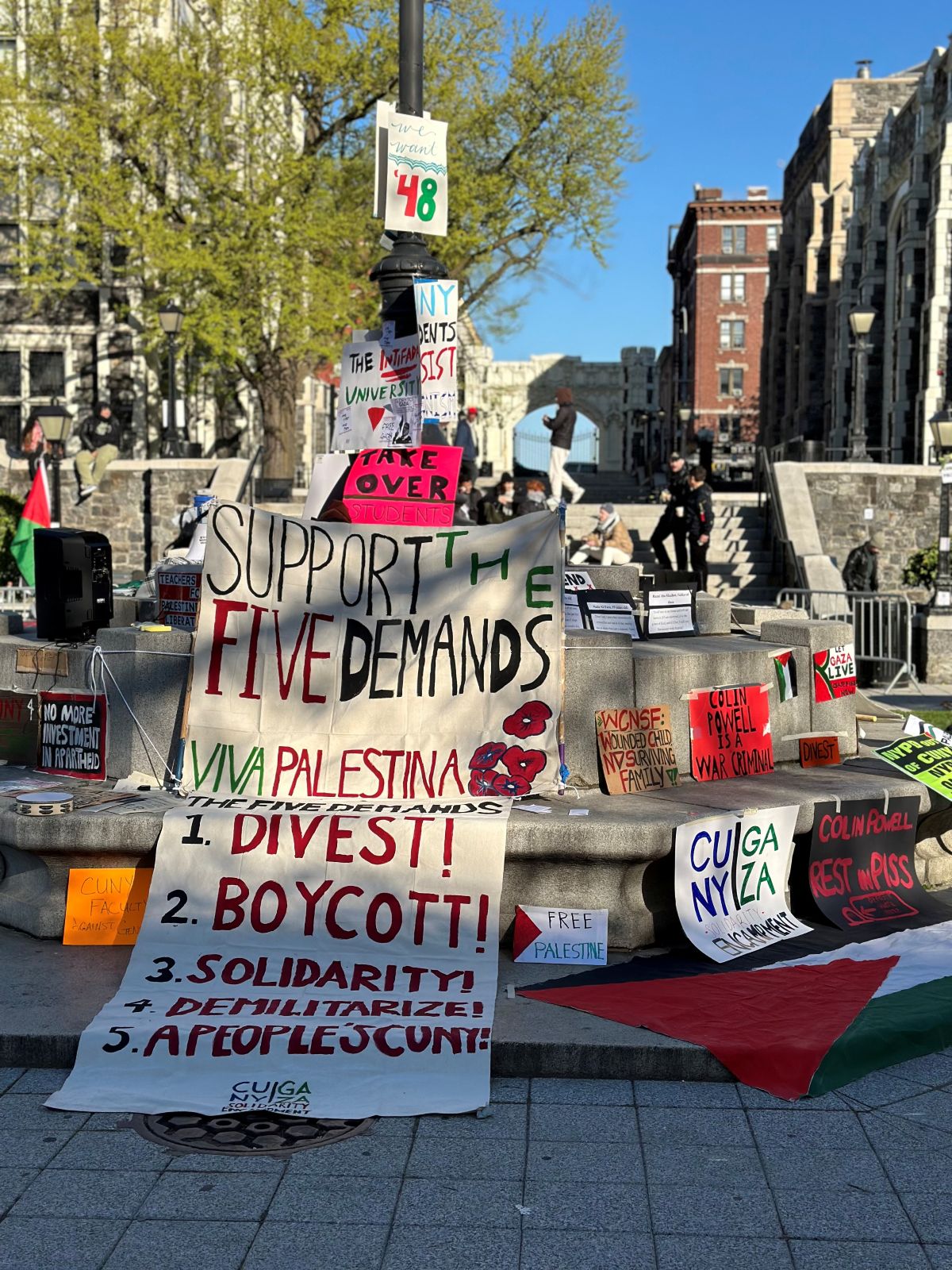
I was there the first day with Amanda. We all went around in the middle quad. At the grassy areas, there were the tents, and then there was a pole in the center. It was like a circle where people could walk around, and there we laid down like posters and flags, et cetera.
[Sound of crowd chanting]
Amanda: And ultimately, I think, it was a lot of planning, and then a strong system in terms of, like, fulfilling basic necessities was enacted. In terms of the bathrooms, a lot of stores, like, you know, in the community, like, offered up their space for bathrooms for people to use, which was amazing. And like, people who lived nearby offered their showers. So it very quickly, in that short amount of time, like, became so community based and really kind of showed the possibility of, like, community care, like real community care. And I think that was one of the strong suits for the encampment.
And honestly, I think, ultimately, CCNY was a really great spot because of The Five Demands in 1969, the Black and Puerto Rican students, their uprisings.
Thayer: This City College encampment took inspiration from the 1969 encampment at the same campus. In 1968 and again in 1969 amid uprisings around the U.S. and the world, students at CCNY issued Five Demands to the administration.
The first of these demands was for “a separate school of Black and Puerto Rican studies.” Not all the demands were met, but a department of urban and ethnic studies was established at the college in the fall of the next year.
The 2024 Gaza Solidarity Encampment at CCNY built on the work of their predecessors and established a New Five Demands. The New Five Demands called for divestment from Israel, an academic boycott, solidarity with Palestinian liberation, removal of police from campuses, and a return to a tuition-free CUNY, which had existed until 1976.
Amanda: And then there was also a lot of political education programming and so on.
Thayer: One piece of that programming included a call from Mumia Abu Jamal that they amplified so it could be heard by everyone at the encampment.
[Sound of crowd cheering]
Mumia Abu Jamal (heard over loudspeaker): I am a student of the late, great Frantz Fanon …
Amanda: That really great moment, a phone call with Mumia where he was calling from prison.
Mumia (heard over loudspeaker): … I know that right now, the people of Gaza are “the wretched of the earth.” And they are fighting to be free from generations of occupation …
Amanda: Amplifying that like to a speaker, like I think that, that moment is like frozen in time, hearing him speak.
Thayer (in interview): What was it for you about what he said that felt powerful?
Amanda: Yeah. Yeah. Sure. This kind of back and forth with the listeners, like, in this love, like, this love that was kind of like, it felt so, it felt so close, in a way, like, everyone who was listening, it just had this like great amount of love for Mumia. And, like, when Mumia was making his call, when he said, you know, like, “Make your demand beyond like ceasefire,” right? Like, “Cease occupation,” and then the students like everyone there chanting “cease occupation.”
Mumia (heard over loudspeaker): … Cease Occupation!
Crowd cheering: Cease Occupation! Cease Occupation! Cease Occupation! Cease Occupation!”
Amanda: That was like, I mean, it’s like so hard to put into words, especially after CUNY GSE and like going forward, it’s been harder to put things into words. Which, I think might be a good thing because there’s it’s just more action-oriented, but I can’t even describe it, it just feels like it feels so embedded and it feels like such a drive and like just kind of, the power of that moment, and it was like less than 10 minutes and like still like it’s like I think for everyone that, I mean, everyone there was in tears. The love was so palpable and the admiration and the respect for Mumia.
Thayer: Both Amanda and Sal spoke of the effervescent yet transformational qualities of the encampment’s community, and the collective politics they created together.
Sal: To me, the encampment was kind of like the potential … the potential future that people want, right? That people can live and eat and breathe and exist freely without their hard work contributing to other people’s deaths. In a way, that’s connected and built together. You know, that kind of community is kind of what I feel me, others, Amanda, and people who were organizing for this encampment and who came to this encampment want in their future.
Amanda: Yeah, I think, I think it was like such a, it was such a moment of like possibilities. And at the same time, like, I felt like it was kind of like an end to things like the end to the existing systems, which at the same time can be scary, which is like, you know, you have to … in order for these new possibilities, right, you’re doing this against the state, against the system, right? Revolution is, is illegal, it will never be accepted by the state. It was a kind of, like, you can’t look back now. You can’t backtrack anymore, and well, now we have to think about how we’re going to move forward. Because this is just like very much a small blueprint.
Thayer: The raid on the CUNY encampment took place on the night of April 30, 2024. Photos of that night depict a wall of police, and a crowd of New Yorkers who flooded to the campus gates after news of a potential police raid spread.
Police first raided Columbia’s nearby campus before arriving to City College.
The raids were violent and multiple injuries were suffered by the encampment members.
Sal: Vincent Boudreau, the president of City College, sent out this narrative after the CUNY encampment was dissolved, saying that people attacked public safety officers. But it was actually public safety that had started attacking the encampment members.
Amanda: There’s still that kind of myth that public safety is not going to go as hard on you, or they’re not as bad as NYPD. But in fact, a public safety officer can be your arresting officer. And they’re very much tied, and they will brutalize you in any way they see fit. And yeah, I mean, and then it goes into like the US$4 million that was put into CCNY for a private security firm.
Sal: Yeah, and I think, right, that night, there were videos coming out of people being brutalized by public safety, like being kicked and being attacked in the eyes with pepper spray.
Thayer: Many arrests were made at both campuses, but one clear difference emerged: 112 people were arrested at Columbia. And 46 were charged, all with a misdemeanor. Meanwhile, more than 170 people were arrested at City College, and 28 of them were charged with the much higher charge of a felony. Felonies are life-altering charges including years in prison.
No other campus encampment raids in New York City resulted in felony charges.
This group of CUNY community members carrying felony charges has come to be called the CUNY 28. As of May 2025, 20 of those charges have been either dismissed or drastically reduced. Still, eight of those individuals continue to face the charge of felony.
A conviction of these students as felons would expand the prosecution of pro-Palestine organizers across the U.S.
Sal: Columbia University students, they were given a level of privilege that the CUNY encampment members were not. They were allowed to leave earlier. They were given lesser charges. And the reason that CUNY students and CUNY members and CUNY community were given higher charges and kept longer was because, one, CUNY wasn’t willing to fight for us. And, two, because we are working-class immigrants that are in a public university.
And so, we are in a perfect state to be made an example of, right? They want us to believe that there’s nothing we can do against them. It’s part of their intimidation tactic. If we get made an example out of, then those private school students will fall in line.
Amanda: You know, this clear coopting of texts and work by revolutionaries, by radicals, right, like, June Jordan, Malcolm X, Kwame Ture, right, in these institutions, in these universities, that was something that I was kind of disillusioned to, the kind of coopting in my earlier years, you know, in undergrad, I was like, “Wow, like, these instructors are amazing. They believe in revolution.”
But ultimately, that was not the case. It was just like, the text being coopted, made palatable, right? Made it so you feel like you’re doing something by reading it, but not ever making those connections to practice.
Which ultimately is saying that the institutions are “not a political space.” It’s like, you have to remain “neutral,” and by being neutral, it means you have to agree with genocide, which is, you know, not very neutral. But ultimately that was something that was learned.
Sal: Yeah!
Thayer: In April 2019, the City College of New York issued an official dedication to the 1969 campus takeover on its 50th anniversary. One year after the 2024 encampment, CUNY still has not dropped the charges against the remaining eight of the CUNY 28. And as of this recording, things have also changed at Columbia, which, like many universities, has had millions of dollars in funding frozen by the federal government as a means to further repress pro-Palestinian campus protests, as well as target diversity, equity, and inclusion programs and transgender policies with defunding. Columbia, along with many universities, has willingly acceded to these reactionary priorities.
On top of this, the U.S. government is pursuing waves of arrests, detentions, and deportations of activists and migrants. Many university administrators have been active in enabling ICE, the U.S. Immigration and Customs Enforcement agency, and DHS, the Department for Homeland Security, to take people into captivity from their campuses and university housing.
In retrospect, how will these universities come to represent their own role in this new era of McCarthyism? One aspect is already clear: By repressing objection to the U.S.-Israeli genocide of Palestinians, so-called liberal institutions, like the universities, were central in laying the ground for expanding of the authoritarian arms of the U.S. state.
Eshe: Thayer Hastings is a Ph.D. candidate in cultural anthropology at the CUNY Graduate Center in New York City. His dissertation focuses on everyday modes of documentation in contemporary Jerusalem, where Palestinians have to prove their presence to the Israeli state in order to maintain access to their homeland, and how this changes the way we understand political belonging.
SAPIENS is hosted by me, Eshe Lewis. The show is a Written In Air production. Dennis Funk is our program teacher and editor. Mixing and sound design are provided by Dennis Funk and Rebecca Nolan. Christine Weeber is our copy editor. Our executive producers are Dennis Funk and Chip Colwell. Audio used in this episode comes from PrisonRadio.org and from the CUNY Encampment Archive hosted at gcadvocate.com
This episode is part of the SAPIENS Public Scholars Training Fellowship program, which provides in-depth training for anthropologists in the craft of science communication and public scholarship, and is funded by the John Templeton Foundation.
