










Listening Against the Threshold of Pain
If you missed Uzma Falak’s previous SAPIENS poems, you can find them here.
Anatomy of Silence
In the city of
lashed tongues
gashed throats
bleeding ears
LED screens and projectors
wired to sound amplifiers
blare the Minister of Stolen Time’s
Independence Day speech
across empty streets
lashed tongues
gashed throats
bleeding ears
also known as a tourist paradise
In the dispossessed land,
it is the usual scenery:
soldiers guarding empty streets
a labyrinth
of checkpoints
razor wires
steel barricades
perpetually shifting
In the dispossessed land,
it is the usual scenery:
vertigo
Participant Observation
In-flight entertainment screen
shows an Incredible India ad on Kashmir
by the Ministry of Tourism
as I fly from Frankfurt to New Delhi
[1]
[1]
I arrived in Kashmir in June 2019 for my fieldwork. On August 5, 2019, India unilaterally revoked Article 370 of its Constitution, stripping Kashmir of its nominal autonomy. We woke up to the sound of helicopters, drones, and curfew announcements. Tens of thousands of additional Indian troops were brought into the Valley. Spools of razor wire dotted the streets as new checkpoints and barricades emerged. A communications blackout was imposed marked by the suspension of mobile networks, landlines, internet, satellite television, newspapers, and postal services.
for my “fieldwork” in Kashmir
Opening scene:
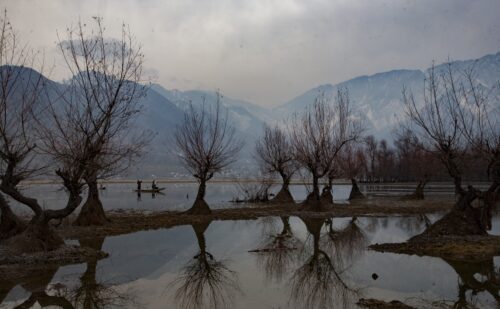
a solitary boat in a serene lake
[slow motion]
[rhythmic sound of oars] [water lapping]
[birdsong] [soft breeze]
[a musical rendition of Habba Khatoon’s poetry]
[2]
[2]
Habba Khatoon is a 16th-century poet from Kashmir.
Last scene:
screen fades to black
an uncanny silence devours sound
as text appears:
Where time stands still
As the flight
from New Delhi lands in Srinagar
we are instructed to
pull down our window shades
on the recommendation of the Ministry of Defence—
current situation, security regulations
so on
and so forth
As the plane shudders on touchdown,
tourists and soldiers on flight
cheer, clap, jump
repeat
Janat e Kashmir—
Paradise of Kashmir,
a large screen glows
above the baggage claim
at Srinagar airport—
a military garrison
[3]
[3]
Established in 1947 by the Indian Air Force, Srinagar Airport includes a civil enclave administered by the Airports Authority of India.
Two months later,
the Ministry of Ruins
once again
ransacks our time
seizing its throat
stealing its breath
slashing its heart
until it bleeds to stillness
while the Imperial Clock keeps striking
In the dispossessed land
it is the usual scenery:
a little pixel dinosaur declares
Unable to connect to the internet
indefinite curfew
lacerated bodies
dead ends
night raids
soundproofing
no signal
crackdown
snap
cut
suspend
repeat
In the dispossessed land
it is the usual scenery:
silence beaten into a grammar of terror
slashed larynxes
damaged eardrums
on display in glass cabinets
also known as a Museum of Normalcy
PLEASE DO NOT TOUCH
In the dispossessed land
it is the usual scenery:
dossiers of colonial crimes
tendered as peace treaties
In the dispossessed land
it is the usual scenery:
Imperial Clock ticking progress
MOVE FORWARD
In the dispossessed land
it is the usual scenery:
PROVE YOUR IDENTITY
STOP
Stop.
On Record
All characters appearing in this work are fictitious
Any resemblance to real persons, living or dead, is purely coincidental
A voice fills the interrogation room
as the Noise Controller plays a phone audio,
a dream narration:
interrogatee holding two envelopes
one in each hand
standing against the sky
slashed by a
building of mirrored interiors
and echoing hallways
housing the Imperial Clock
Noise Controller
declares the dream to be a covert operation
a coded signal
a prosecutable offence
In the dispossessed land
it is the usual scenery:
Dream Police
off the leash
Camp Sound
On a video call home,
I listen to drones
sirens
explosions
resonating through the city’s sternum
Ausländer raus—
[4]
[4]
This is a German far-right anti-immigrant slogan.
Foreigners Out
Two teens sing into the night
gliding on a kick scooter
across my street
I listen to roof tiles
crashing to the ground
through an aluminum rubble chute
outside my window
tremoring through my teeth
my body
summoning sounds
shaking my bones,
growing up
inside
the shape of a scream
I listen to police sirens,
emergency announcements
ordering evacuation—
an unexploded World War II bomb
near Heidelberg Central Station
I wander
into the December night
alive with alarms
shattering the regulatory Ruhezeit—
[5]
[5]
Ruhezeit, German for “quiet time”: legally enforced quiet hours in Germany.
rising clamor of uncertainty—
home
A voice rises
into the
autumn night wind
in Altstadt
at the student encampment for Palestine
in the university square,
my hands reach for other hands
for the first time in a long, long while
Noise
Ek sur—
One melody,
a multilingual song airing in the nineties:
mile sur mera tumhara / tou sur bane hamara—
when your note joins mine / a collective melody emerges:
voice of an Indian classical singer
[cut to]
an actor playing a boatman
rowing a flower-laden boat across Dal Lake
as sun sets in the background,
singing merrily in Kaeshur:
chaen taraz tai myaen taraz / Ikwat’e baen ye saen taraz
when your note joins mine / a collective melody emerges
A national integration song
celebrating unity in diversity
conceived by the Ministry of Information and Broadcasting,
first telecast in 1988
on the 41st Independence Day
—an anthem to rising India
A year later in Kashmir,
subterranean songs gushed forth
refusing a coerced collective melody
nationalist unisonance—
In the dispossessed land
it is the usual sound:
Radical Noise
Listening Against the Threshold of Pain
For the dispossessed—
inscribing their land into their throats—
it is the usual scenery:
a brief letter by the Gatekeepers
announcing your place in a queue—
bodies forced into stress positions
of exile
wakefulness
waiting
For the dispossessed—
lugging their land on their backs—
it is the usual scenery:
listening on loop
to a recording you made
walking home
(the last time I walked home
was one hundred thirty-eight million, one hundred thirty-two thousand, eight hundred sixty-four seconds ago)
one-minute chorus
cradling my homelessness
tongues in rhythmic recitation
throats soaring
bodies oscillating
burning
in
wait
homebound
Inside my bones,
I listen to frequencies
escaping the Noise Controller’s sensor
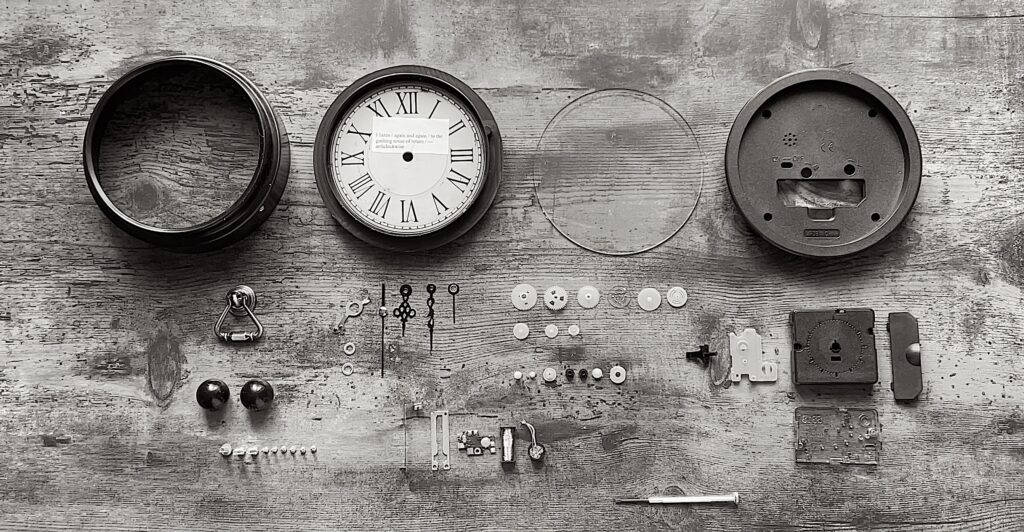
I listen to the Imperial Clock
being smashed to smithereens
I listen
again and again
to the gushing
noise of return
—anticlockwise

Uzma Falak was born and raised in Srinagar, Kashmir. She is a doctoral student in anthropology at the University of Heidelberg and a lecturer at the University of Tübingen. Her academic work, poetry, essays, and reportage have appeared in several publications, such as English Language Notes, Anthropology and Humanism, The Baffler, and collections such as Poetry as Evidence, Insurgent Feminisms: Writing War, Can You Hear Kashmiri Women Speak?, among others. In 2017, she won an honorable mention in the Society for Humanistic Anthropology’s Ethnographic Poetry Award. Her writings, visual and sound work have been showcased at several galleries, festivals, universities, and theaters such as the Tate Modern Exchange, Rizq Art Initiative, Art Gallery of Guelph, Rice Cinema, among others. Recently, she was an artist-in-residence at Melbourne’s Liquid Architecture as part of the cohort Capture All: A Sonic Investigation, focused on exploring sound/listening as resources of power, capture, and extraction. Falak is the 2025 SAPIENS digital poet-in-resident.
