





Dreamscapes of Refusal: A Chorus
“Dreaming has a share in history.”
—Walter Benjamin, Dream Kitsch
1
A green scarf speckled with silver sequins
drapes loosely over her
shimmering like a night sky awash with stars
She gathers her worn-out notebooks
inscribed with fragments of songs
repeated over and over,
unrelenting—
like it is her way to keep time
Lift your veil, my precious
I shall call out to you
In her attic she tends to her broken spinning wheel
recalling the massacres of the ’90s
she drifts away to a landscape of death, over and over:
“border … bones … snow … limbs … crows”
She gathers her dreams
as she spins the wheel—
setting motes of dust afloat in the afternoon light:
“I see demolished and burnt homes in my dreams: ruins, death, and desolation. I dreamt of Yunis after he was killed. He was running. I called out to him, ‘Yunis, Yunis, what are you running toward?’ ‘A horse,’ he answered. ‘What horse?’ I asked. ‘A Buraq,’ he said. I saw the winged horse in the sky. I called out to him, ‘Yunis, Yunis, I am waiting.’ But he flew away.”
2
Summer breeze rustling through the pines
drifts in through the window kept ajar
in the rose-colored room
where she gathers broken verses of a song
O’ forest bird …
singing names of the dead,
her cadence rising and falling
as if traversing a forest—
her song likening the departed to the forest birds
her gaze wanders to the distant mountains
as she gathers a cry, a dream, and a dead man’s watch:
“I loved him. I urged him not to cross the border. The day he was killed, I walked up to the forest. My cries and screams resonated through the forest. He once asked me to wear his watch as a keepsake, but I refused. In my dream, he tells me he is hungry. I walk up to his grave carrying a large vessel of rice. The custodians stop me. He asks them to let me through. When I see him, he says he was never hungry—he only wanted to see me. He was in a beautiful garden. It isn’t easy, is it? To witness so many roses withering.”
3
A black-and-white photo of her son
tucked inside her songbook
quietly converses with a ghazal
Oil in the pan sizzles on the stove,
its coil glowing red
“A song,” she tells me, “must have a strong root”—
“I gather the song in my heart
before my voice carries it”
“I was spinning yarn as a song kept
weaving itself within me,”
she says—
remembering an elegy she first sang in the ’90s
A jasmine branch withered while blooming
Graves of the impeccant have taken possession of the earth
In her song,
garden comes undone—
cradles a catastrophe,
her voice quivers:
“After my son’s arrest, I fell apart. I dreamt vividly. I dreamt about him, everything he was enduring; the interrogation, torture, his ordeal from one prison to the next. How could I have known? Loss upends all known boundaries. Grief seeped into me, and songs gushed forth from within. Alas, this world and its tribulations!”
4
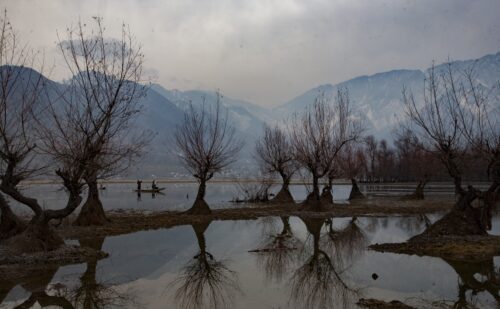
Bare trees keep watch
with the dead
in the martyr’s graveyard—
under an azure sky
children flit and skip,
waiting for snow
“Why are you looking at my face,” her brother once asked her
“An absence is taking root in my heart,” she answered
“He was killed in an apple orchard,” she tells me
as we walk into his room—
his books, radio, pens, prayer rug
resonant with absence
She gathers his face:
“He lived as if he was on a journey. In our dreams, we witnessed his departure repeatedly, even when he was still here. After he left this world, he visited me in a dream and said he would help me in the orchard with the pruning. I told him he had come home after a month and shouldn’t trouble himself with tending to the orchard. I spread my pheran on the ground for him to sit. … Our grandmother passed away shortly after. Before her death, she told us she saw my brother in a vision—his face, radiant. He was holding an engraved copper vessel filled with rice. ‘I am waiting for you,’ he told her.” [1] [1] A pheran is a loose, long upper garment traditionally worn by both men and women in Kashmir. It offers warmth and comfort during Kashmir’s harsh winters. Indian troops have profiled and targeted individuals wearing pheran and have imposed restrictions on its use. In more than one instance, government directives have also prohibited wearing the garment in certain institutional contexts. Pheran has also been subjected to exoticization and cultural appropriation—often reduced to a mere aesthetic object in the Indian imaginary.
5
I cross Gaw Kadal—
[2]
[2]
The Gaw Kadal massacre is among the first in a series of brutal massacres perpetrated by the Indian forces since the 1990s. On January 21, 1990, thousands of men and women took to the streets to protest the human rights violations committed by the Indian forces. As the procession reached the bridge (Gaw Kadal) over the Jhelum River, Indian paramilitary forces opened indiscriminate fire with automatic weapons—killing at least 60 people and injuring hundreds. However, survivors recall the death toll being much higher, as many people jumped into the river to escape the gunfire. Witnesses recount that troops continued firing at the injured as they lay on the ground and also chased some of the protesters through the lanes. The bridge was strewn with dead and wounded bodies. Many believe that the number of deaths would have been even greater had 24-year-old Abdul Rouf Wani not stepped in front of a machine gun aimed at the crowd and taken 32 bullets to his chest.
the bridge cradling memory of a massacre
I reach her threshold
bearing hues of the fading day in my palms
I ascend the dark stairway
resounding in her elegy for her son
killed in 2010—
pellets piercing his aorta
“When my son was killed,” she says,
“something strange took hold of my heart,
and I sang”—
“verse by verse, I stitched together a song”
Fading light
glimmers on the gold-threaded ferns and leaves on her pheran
as she sings:
In your longing—a gaping void, darkness descends
In a 2010 journal,
she writes to her dead son:
December 11, 2010:
… please visit me in my dreams tonight
December 9, 2010:
I implore you, please visit me in my dreams …
November 26, 2010:
… for my sake, please visit me in my dreams
6
She walks the autumn landscape,
stops by a rivulet
pale-violet wildflowers emerging from a narrow crevice
quiver
as she cups water in her hands
washing her face, over and over—
as she recalls a dream of her disappeared son:
“It was a long time ago, on the night of Qadr, when we still lived at our old house. … I dreamt of him. ‘I am alive, I am in their custody, they have hidden me mother. They tell me, “Your mother is searching for you,”’ he told me in the dream.” [3] [3] The Night of Qadr (Laylat al-Qadr) is a venerated night of peace that commemorates the revelation of the Quran to Prophet Muhammad through angel Jibrīl (Gabriel). It falls within the last 10 nights of Ramadan during which the believers are encouraged to seek it.
7
In your absence, mother, I have turned to dust, she hums
as cicadas sing in chorus
She opens a small box cradling
her dead mother’s belongings:
a scarlet comb, a strand of hair, an ochre hair clip,
a white thread holding on to a pair of gold hoops,
a mirror—
she recalls the day her mother was wounded,
July 31, 2010:
“I was there when they fired at her—
five bullet wounds
spinal cord, left lung, left kidney
leaving her paraplegic for a year
before she left me.
I tended to her wounds
I wrote poems for her—
and set them ablaze in her absence”
She blows on a dandelion
its fragile form falling apart—
“She often visits me in my dreams. A few nights ago, she led me into a garden. ‘What is it, mother dear?’ I asked her. ‘May I be sacrificed for you, tell me, what is it?’ She said, ‘I have something to ask of you. Will you do it?’ ‘Yes, mother dear, tell me—tell me what is it,’ I kept repeating. And suddenly, I awoke.”
8
I walk along the ancient canal
once lined with quince trees,
a thriving waterway connecting neighborhoods—
now smothered
Birds congregate in the skies
tracing mystic patterns
as I enter her door
When her father passed away,
a spiritual guide visited in a dream
handing her a piece of paper
and asking her to read
She uttered her first verse in Kaeshur: [4] [4] Kaeshur (also Kashmiri) is among Kashmir’s native languages.
Wandering in search of a flower garden
I traversed Mount Qaf
Bulbul sings laments,
mourns—
in your longing, beloved,
I came undone
once a blooming iris—
in your longing, beloved
When B. was killed,
“Sky turned dark,” she tells me
“as it does in mourning—
a storm shook everything in it wake …
hundreds of wounded eyes”
A song surged forth from within her,
in Urdu:
O’ tyrants, you may oppress us a thousand times
We, shaheed, remain in Divine’s care—
[5]
[5]
The word “shaheed” literally refers to “witness” and also bears meanings of “martyr.”
I listen to her invocations as songbirds cry:
“When a verse gushes forth, the body shivers and breaks into sweat. It liberates you from ordeals of the world, devouring all your attention. One keeps uttering verses, but the listener cannot listen. The addressor and the listener are in two separate worlds. Around midnight, my father and a spiritual guide would visit me in my dreams. Until early dawn, they would repeat verses over and over until I learned them by heart. Upon waking, this would begin again—continuing for days, sometimes months. It is an unending chronicle—it is like a tree, my dear: There is a root, but the branches know no end; from a branch, a shoot emerges, and from it, another …”

Uzma Falak was born and raised in Srinagar, Kashmir. She is a doctoral student in anthropology at the University of Heidelberg and a lecturer at the University of Tübingen. Her academic work, poetry, essays, and reportage have appeared in several publications, such as English Language Notes, Anthropology and Humanism, The Baffler, and collections such as Poetry as Evidence, Insurgent Feminisms: Writing War, Can You Hear Kashmiri Women Speak?, among others. In 2017, she won an honorable mention in the Society for Humanistic Anthropology’s Ethnographic Poetry Award. Her writings, visual and sound work have been showcased at several galleries, festivals, universities, and theaters such as the Tate Modern Exchange, Rizq Art Initiative, Art Gallery of Guelph, Rice Cinema, among others. Recently, she was an artist-in-residence at Melbourne’s Liquid Architecture as part of the cohort Capture All: A Sonic Investigation, focused on exploring sound/listening as resources of power, capture, and extraction. Falak is the 2025 SAPIENS digital poet-in-resident.
