














In existence for more than 70 years, the Korean Demilitarized Zone (DMZ) is the site of the longest ceasefire in the world. What can this region teach us about the long, intended—and unintended—consequences of this form of a truce?
In this episode, sociocultural anthropologist T. Yejoo Kim uncovers how residents have been surviving through decades of sonic violence and propaganda, and explores recent developments in such long-lasting psychological warfare. She also details how a former excavationist remembers discovering human remains at the DMZ. Even after more than 70 years, the ceasefire allows war to reverberate through the skies and unsettle the earth below.
Yejoo Kim is a sociocultural anthropologist researching the political economy of the Korean DMZ. She is a Ph.D. candidate at the University of California, Los Angeles. Her dissertation builds upon the anthropology of borders and the economy, diaspora and transpacific studies, and critical disability frameworks. Her research has been funded by Fulbright and the Korea Foundation.
Check out these related resources:
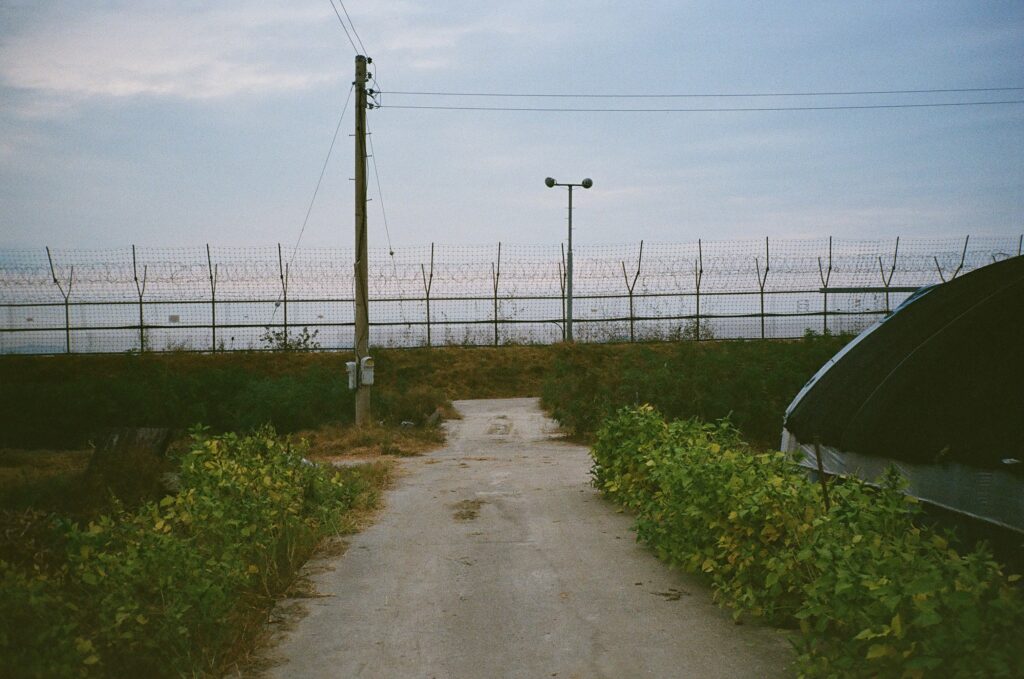
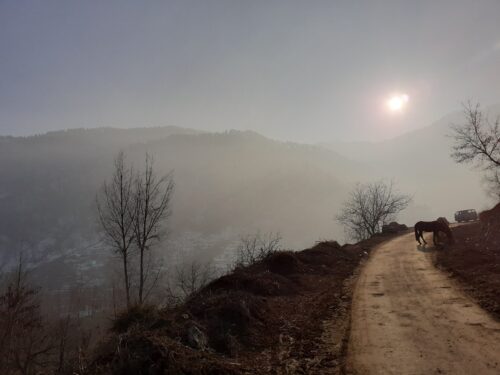
One morning, T. Yejoo followed propaganda sounds to the edge of a farm near the DMZ, close to the military barricade.
T. Yejoo Kim
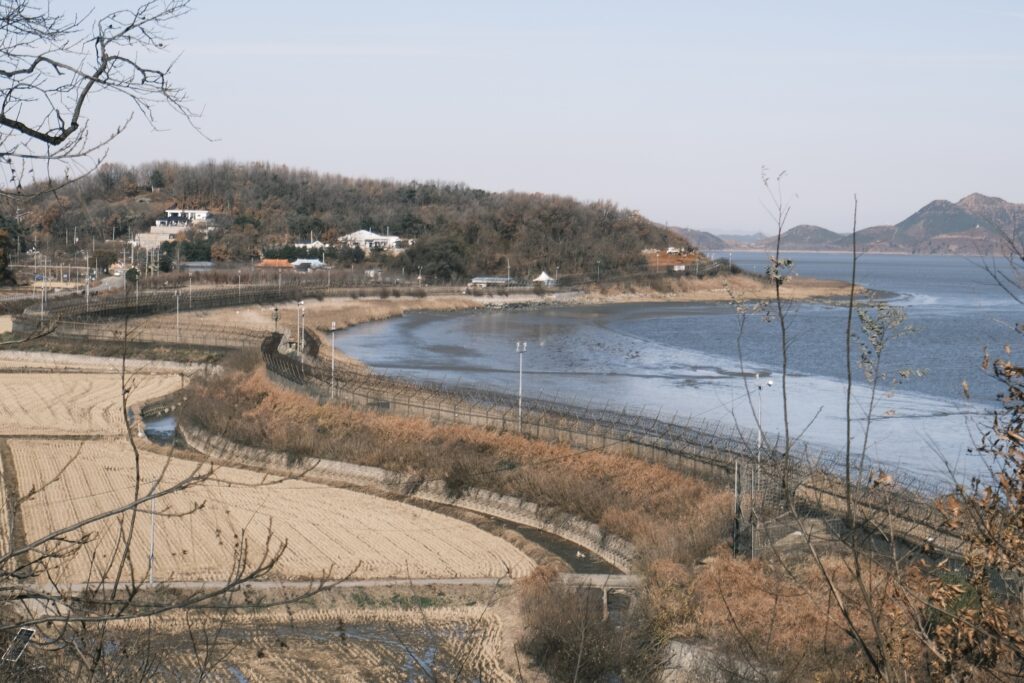
Military fencing in the civilian-controlled section of the Korean DMZ separates villagers from their nearby neighbors in North Korea.
T. Yejoo Kim
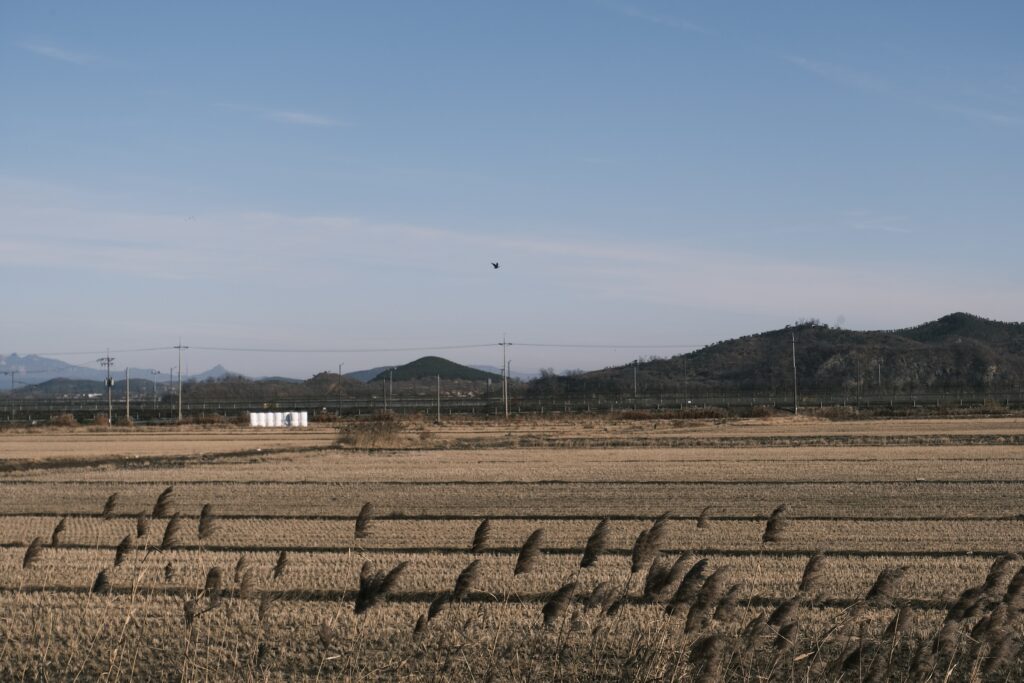
Loudspeakers in North Korea can be seen from a backyard in South Korea.
T. Yejoo Kim
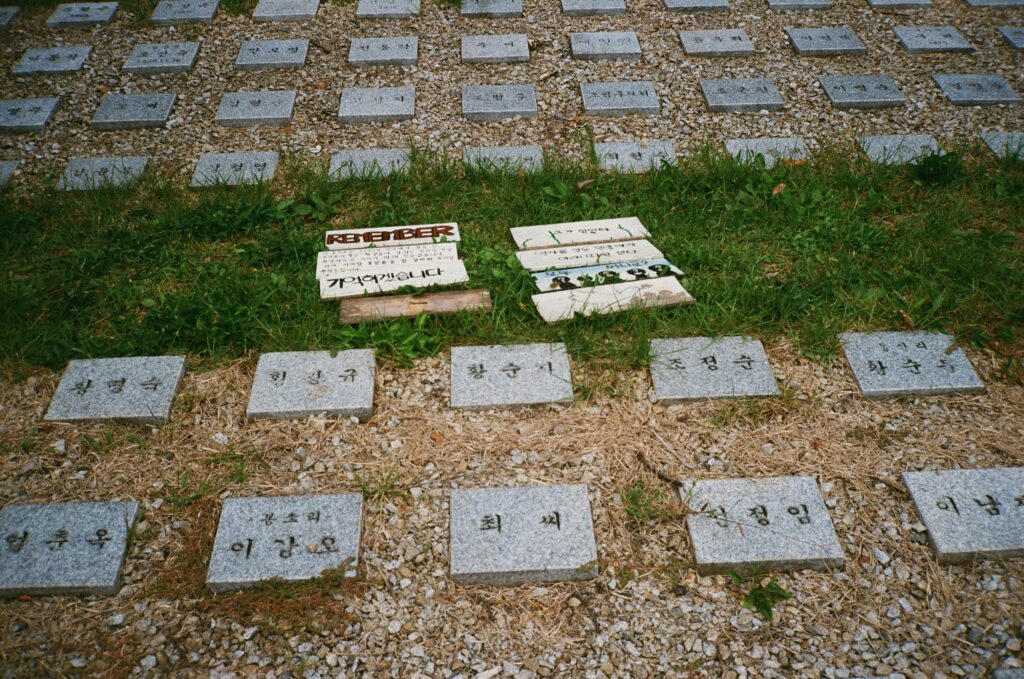
A memorial site commemorates civilians massacred near the Korean DMZ by family members. Many of their bodies are still missing.
T. Yejoo Kim
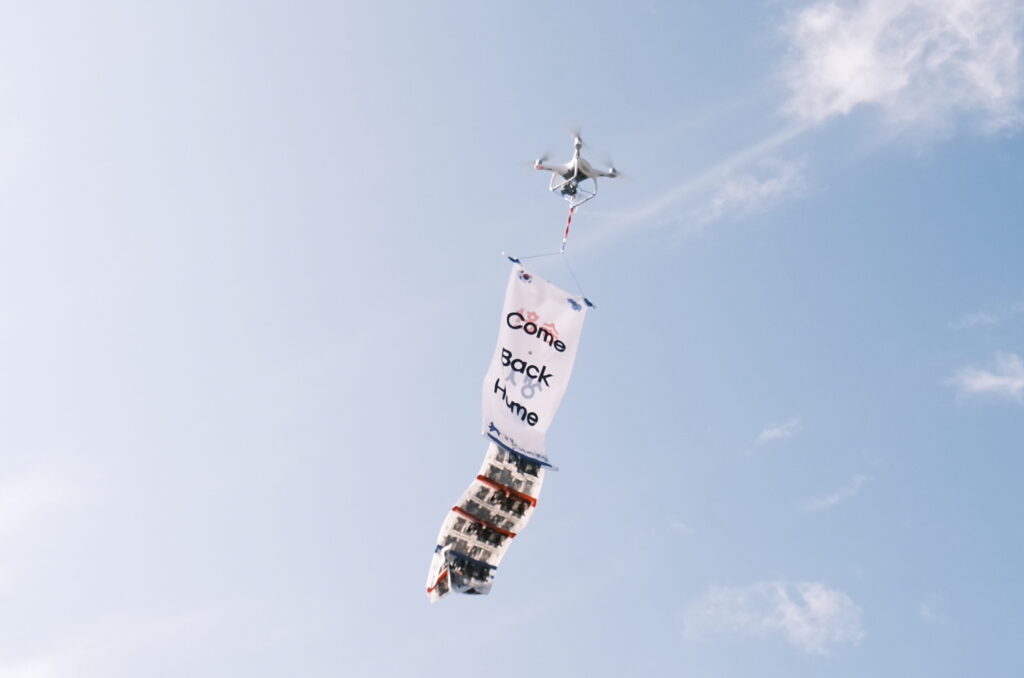
Among the many kinds of propaganda balloons and drones sent by North Korean defector and abductee groups from South Korea are drones such as this one, which carries a list of family members who were abducted by North Korea.
T. Yejoo Kim
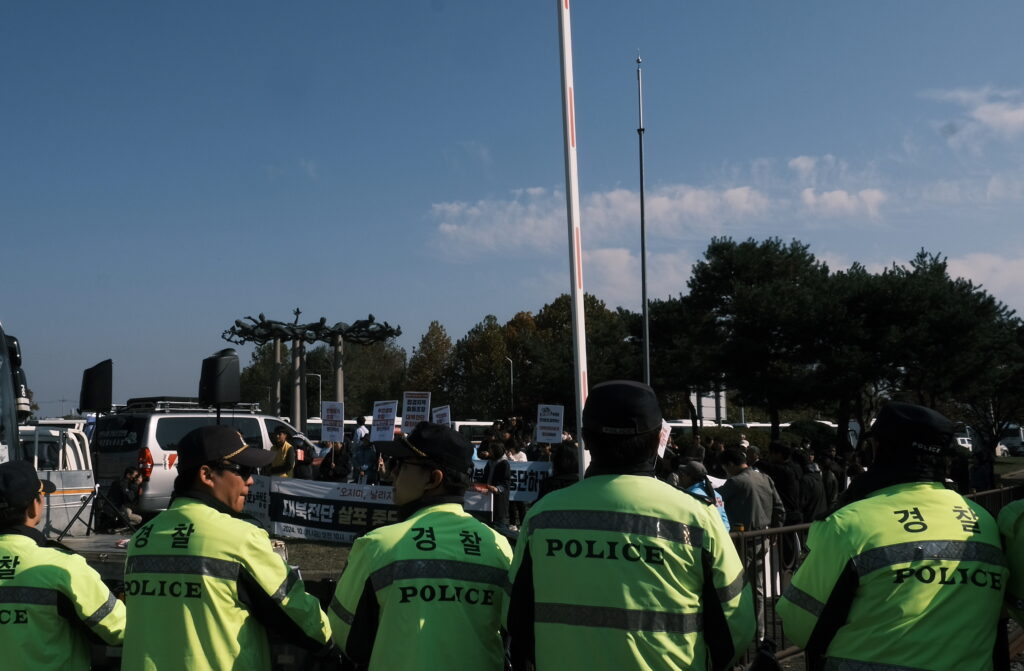
Police block local residents of the Korean DMZ who protest against groups sending propaganda balloons and drones into North Korea.
T. Yejoo Kim
SAPIENS: A Podcast for Everything Human is produced by Written In Air. The executive producers are Dennis Funk and Chip Colwell. This season’s host is Eshe Lewis, who is also the director of the SAPIENS Public Scholars Training Fellowship program. Production and mix support are provided by Rebecca Nolan. Christine Weeber is the copy editor.
SAPIENS is an editorially independent magazine of the Wenner-Gren Foundation and the University of Chicago Press. SAPIENS: A Podcast for Everything Human is part of the American Anthropological Association Podcast Library.
This episode is part of the SAPIENS Public Scholars Training Fellowship program, which provides in-depth training for anthropologists in the craft of science communication and public scholarship, funded with the support of a three-year grant from the John Templeton Foundation.
Ceasefire From the Earth and Sky
Eshe Lewis: What makes us human?
Anahí Ruderman: Truly beautiful landscapes.
Nicole van Zyl: The roads that I used every day.
Thayer Hastings: Campus encampments.
T. Yejoo Kim: Eerie sounds in the sky.
Eshe: What makes us human?
Cecilia Padilla-Iglesias: Division of labor.
Charlotte Williams: Colonialism.
Giselle Figueroa de la Ossa: The value of gold.
Dozandri Mendoza: Fun. Dance.
Justin Lee Haruyama: Cultural and social interactions.
Luis Alfredo Briceño González: Hopes for a better future.
Eshe: Let’s find out! SAPIENS: A Podcast for Everything Human.
[INTRO ENDS]
Eshe Lewis: What happens when a ceasefire never ceases? If an agreement to end a war does not entirely fulfill its promise, then how does a ceasefire shape the way we hear, feel, and live out our everyday lives?
Today’s story is from anthropologist Yejoo Kim, who is currently based in Seoul, South Korea. She’s reporting from the site of the longest ceasefire in history—the Korean Demilitarized Zone, otherwise known as the Korean DMZ. Yejoo is currently finishing her doctoral degree in anthropology at UCLA and has spent the last decade researching issues related to the ongoing Korean division.
For this episode, Yejoo guides us through the sounds and textures of what an ongoing ceasefire feels like today.
And just a note, this episode may contain some graphic descriptions and unsettling audio for listeners.
Here’s Yejoo.
T. Yejoo Kim: When we think of the Cold War, we often think of the decadeslong rivalry between two Western atomic superpowers, the U.S. and the Soviet Union. As the story goes, this rivalry divided the world in half, inviting incredible public fear over political persecution and nuclear devastation. As the Soviet Union began to crack through the Gorbachev years, the world became optimistic about an end to the Cold War. So, when the Berlin Wall fell in 1989, the world tuned in to see the broadcasts of East and West Germans reuniting, celebrating alongside them, and breathing a collective sigh of long-awaited relief.
This is the story that we’re often told about the Cold War, a timeline of the world divided neatly between the pre and post-1989 years. But, what if I told you the Cold War never really ended?
This is certainly the case for one of the earliest and, now, longest conflicts of the Cold War, what is known in the West as the Korean War or “Forgotten War.” Though a ceasefire was drawn in 1953, Korea still remains divided and the North and South are still at war with each other. In this episode, I take you to a place where the reality of the Cold War is perhaps the most inescapable, the Korean DMZ.
The Korean DMZ was created at the end of the Korean War as a part of the Korean Armistice Agreement in 1953. The U.S., China, and North Korea were signatories on this ceasefire without South Korea present. It’s an exclusion that many legal and military historians have long noted as a major impediment to reaching lasting peace between the two Koreas. The agreement promises to “ensure a complete cessation of hostilities … until a final peaceful settlement is achieved.” But the timeline of reaching a peace settlement was never fully detailed nor carried out in earnest. And South Korea’s role here has long been ambiguous. To this day, the DMZ remains one of the most militarized buffer zones between two warring states in the world.
Though more than 70 years have passed, the two nations remain gridlocked. Now the DMZ has become a more permanent infrastructure that stretches 250 kilometers right through the middle of the Korean peninsula. Though technically a demilitarized zone, it is far from actually being demilitarized. Throughout the decades, there have been countless casualties for U.S., North and South Korean soldiers, and numerous high-profile defections and assassinations. Civilian casualties are also not exempt, such as in the bombing of Yeonpyeong, an island within the DMZ. And just last year, North Korea blew up the only two railways connecting the two Koreas, both a violent spectacle and a political statement that the North was not thinking of reunification.
While the media tends to focus on these events, my dissertation research wants to understand how the militarized reality of the DMZ affects the everyday lives of residents here. For many, the DMZ has become their home, a place where they have staked their livelihood, and my project tries to see how a ceasefire state has affected the local culture and economy of the people who have made homes in this frontline of an unending war.
At the DMZ, the effects of ongoing ceasefire can also be explained through what one hears in the skies and feels in the earth. In this first segment, I follow the eerie sounds in the sky that have come to characterize the sonic footprint of the ceasefire today.
[Eerie, spooky sounds from loudspeakers begin]
It’s 11:57 p.m., in Songhae village around 5 kilometers south of North Korea, and the air is filled with what sounds like the beginning of a Twilight Zone episode. Except, these are sounds you cannot click away with your remote when you’re ready to go to sleep. They will turn on without notice at various points in the night.
[Sounds stop]
The following morning, I go into the local community center, where I find a few older residents and the mayor, Ahn Hyo-Chul, having their morning coffee. I ask mayor Ahn how he would describe the sounds to an outsider.
Ahn Hyo-Chul:
시하는 소리예요. 그러니까 무슨 소리라고 얘기를 못할 정도로 낸다고. 사이렌 소리도 나는 것 같고 그냥 새 질질 끌고 다니는 소리도 나는 것 같고 막 그런다고 그러니까 똑같은 소리가 나는 게 아니야.
Ahn Hyo-Chul (translation):
It’s a really strange sound. Sometimes there are sirens, others when birds are screaming or something like that. It’s never the same sounds.
Yejoo: He describes the strange nature of the sounds. Sometimes he hears sirens, screaming birds. It’s never really the same, he says.
Ahn Hyo-Chul:
그거 틀림없이 스트레스 장애가 일어나서 그랬다.
그래서 야 내가 무슨 스트레스를 받아서 장애 이렇게 하니까 아니야 그래도 너 이제 봐라 갑자기 그러니까 갑자기 그런 거거든.
Ahn Hyo-Chul (translation):
They said without a doubt that my eyesight is due to a stress disorder. So I said how could that be, a stress disorder, but the doctor said this can happen suddenly and I said no and the doctor said yes it’s possible.
Yejoo: Doctors have also told Ahn that he has developed a stress disorder that has affected his eyesight. He takes off his glasses and tells me how he has recently started wearing them because his eyesight has deteriorated. Though the doctors have told him his eyesight will get better if he gets some more rest, this is not something he really has control over.
[Eerie sounds continue]
As the sun rises around 7:14 a.m., we hear the morning birds chirping and residents driving their tractors to the fields as sounds of sirens and ghosts from the North fill the morning air.
Around the village, I see information about psychological counseling services being provided by the government for residents, so I speak to Gyo Gi-sun, who has been living here for the last 50 years about these services.
Gyo Gi-sun:
여기 보면 다 그냥 수면 부족이에요. 다 불면 부족이에요.
차들이 와서 다 해주는데
Gyo Gi-sun (translation):
Here we all are lacking sleep. Insomnia. They say they’ll help.
Yejoo: Everyone here, Gyo explains, has been lacking sleep for months. Though the government says they’ll provide some services, like the counseling services, it doesn’t change the fact that they cannot sleep.
Gyo Gi-sun (cont.):
아무래도 시달리니까 깨고 자고 그러니까 거기다 자꾸 신경 써고
Gyo Gi-sun (cont., translation):
And all, but I keep waking up and sleeping and it’s stressing me out all the time.
Ahn Hyo-Chul:
그래서 처음에는 여기도 그것도 우리도 싫으니까 북한으로 방송원을 보내지 말면 방송을 안 할 거다.
그러면서 그 방송을 못하게 했는데 그건 안 된다니까 그 지랄을 하는 거예요.
아유
Ahn Hyo-Chul (translation):
We even told our military to stop broadcasting into the North because that is the only way the North will stop. But because they won’t stop, they’re also continuing this nonsense. Wow.
Yejoo: Residents have also told me that the South Korean military also needs to stop their own broadcasting. The South Korean government’s response, however, is to provide up to an equivalent of US$7,000 funding for soundproof windows and other minor infrastructural adjustments per household. When I visited the local district office in December, I asked residents if they felt these measures would be adequate for what they needed to live here.
Gyo Gi-sun:
그거 다 하려면 돈 많이 들고 그러니까 자기 자는 방만 한 가지로 하면 그거 되지만 이거 다 하려면 돈 천만 원 가지고 모자라지
Gyo Gi-sun (translation):
If we were to fix everyone’s homes, ₩10,000,000 is not enough.
Yejoo: Here, Gyo and the mayor, Ahn, agree that US$7000 may not be enough for the kinds of adjustments needed in each household, especially the older homes. These grants are just a bandaid on top of a deep-seated injury;
Ahn Hyo-Chul:
모자를 수도 있죠. 그러니까 뭐 더 나오면 1천만 원 이상 되는 건 자부담으로 하는 거예요.
그런 계획으로 지금 하는 거예요. 사람이 똑같진 않잖아.
이 집은 다르고 저 집은 다르고 그러니까는 다 그런 식이에요.
Ahn Hyo-Chul (translation):
It could be lacking of course. Anything that exceeds ₩10,000,000 will fall on the burden of the individual. That’s the plan. Each home is different, so it’ll look different from house to house.
Yejoo: Will soundproofing their homes allow them to forget that they live on the frontline of a never-ceasing war?
Psychological warfare through sound, however, is not completely unique to what we are hearing in the DMZ today. Disturbing sounds such as these have long been used in war, such as the U.S. employing ghost sounds against the Viet Cong during the Vietnam War, and even more recently, with the Israeli army playing sounds of women screaming and babies crying toward Palestinians in Gaza.
In Korea, while the North and South are not in active warfare and technically in a ceasefire, psychological warfare through propaganda leaflets and broadcasting have long been deployed by both states. Here we can make out faint sounds of screaming over sirens in the night.
[Sounds of sirens and screaming]
I asked Ahn, the mayor, if there were set times during which they were able to hear the broadcasts.
Yejoo (in interview):
그 시간 정한 시간이 있었어요?
Yejoo (in interview translation):
Were there no set times in the past?
Ahn Hyo-Chul:
옛날에는 시간이 정해져 있더랬어요. 그거 저 문재인 정부 때는 안 했지만 그때 그때 양쪽 거 스피커를 다 철거했다고 그 이후에는 조금씩 했대.
그래도
Ahn Hyo-Chul (translation):
In the past, the times were set. During Moon’s administration the speakers were taken down, and there was little to no broadcasting.
Yejoo: He explains, the broadcasting stopped in 2018 during the administration of Moon Jae In, the former president of South Korea.
Many people in Korea and around the world will remember the momentous occasion that year when the two Korean leaders, Moon Jae In and Kim Jong Un, crossed over the 38th parallel in the DMZ to shake hands and start paving the way toward reconciliation. Moon’s administration had declared the beginning of a new era of peace, 새로운 평화 시대, and various measures began as a way to realize this inter-Korean vision.
One of these measures that came out of this moment was to stop the propaganda broadcasting that came to characterize the sonic landscape of the DMZ for decades. Broadcasting on both sides of the border usually had set schedules and predictable content. North Korea would blast songs and speeches praising the Kim regime while South Korea would broadcast catchy tunes from trot to k-pop. Meanwhile, residents would learn to tune these sounds out as they worked in the fields. As annoying as these sounds were, they were usually turned on during the day while they were awake anyways.
In 2018, the speakers were removed and residents and soldiers stationed in the DMZ were finally able to experience a calm, a quiet.
[Eerie sounds of wolves howling]
Six years of quiet, however, came to a screeching halt when North Korea resumed their broadcasting in the summer evenings of 2024. And this time, they decided on a different approach. They started broadcasting unsettling sounds, the sounds of ghosts and people screaming, at unpredictable times at night.
[Eerie sounds of wolves howling continue]
I asked Mayor Ahn why he thought the broadcasting began again.
Ahn Hyo-Chul:
이거 시초가 왜 그러냐면 얘네들이 뭐야 우리나라에서 쌀 보내주고 내 보내고 달러 보내고 막 그랬어요.
그러니까 이제 오물풍선이 날아왔다고 오물풍선이 날아오니까 우리나라에서 대북 방송을 또 한 거예요.
그러니까 쟤네들이 가만히 있다가 그 시끄러운 그 방송을 또 한 거라고 지금
Ahn Hyo-Chul (translation):
Why this started in the beginning was because people from South Korea started sending things like U.S. dollars and rice. So the North started sending trash balloons and the South resumed their broadcasting again. They were still for a while until we started broadcasting again.
Yejoo: He pointed to the conservative groups in the South that have resumed sending propaganda leaflet balloons and drones into North Korea recently. These groups would include things like U.S. dollars and rice.
After that, the North started sending trash balloons into the South, and then the South responded by turning on their broadcasting again. The witchy, eerie broadcasting of the North is the most recent response to this escalation of events.
Yejoo (in interview):
근데 여기 이 지역 주민으로서 이런 거 보면 너무 지치지 않아요.
Yejoo (in interview translation):
As a local resident, don’t you get tired watching these things?
Yejoo: So, I asked if they got tired of this?
Ahn Hyo-Chul:
돈으로 해결할 것 같으면 해결해도 되지만 그거 누가 와서 윤석열이가 와도 해결 못 한다고 저 김정은이가 그렇게 하는 거 같아서 근데 여기서 하지 말라는 건 왜 하냐고 방송을 안 해봤으면 저놈들이 방송을 안 했을 거라고 맞아요.
탈북민 단체들이 처음에 삐라 뿌리고 막 그래가지고 그놈들이 오물풍선 일로 내보낸 건데 뭘
Ahn Hyo-Chul (translation):
What can we do? If we can handle it with money, that would be great. But Yoon Seok Yeol won’t do anything. Kim Jong Un won’t do anything, even if we tell them to stop. If we didn’t start, they wouldn’t have done the broadcasting. It’s those North Korean defector groups that are spreading all this trouble with all the trash balloons and such.
Yejoo: In Ahn and the other residents who sat with him that morning, I felt a frustration toward this recurrent state of affairs. Though we tried to laugh it off, their exasperation still felt real. Their frustration wasn’t politically one-sided but expressed toward an inept political leadership in both North and South Korea. Nevertheless, Ahn was particular about his anger toward the conservative groups as the source of his distress.
These groups are made up of those whose family members have been presumed to be abducted by the North, North Korean defectors in the South, and their supporters, many of whom are also supported by religious and political groups in the U.S., including those in the Korean American community.
Sending propaganda leaflets across the DMZ is not new in inter-Korean relations, and they were momentarily blocked by the liberal administration of Moon Jae In that stated that these activities would be penalized with fines and prison time. The law was nullified, however, in 2023 by the constitutional court under the more belligerent Yoon administration that stated these efforts impeded on these groups’ “freedom of expression.” Their freedom of expression may be safeguarded by the court, but residents have expressed that their freedom comes at the cost of their own freedoms: the right to live safely and peacefully in their own homes. Since last summer, residents have been democratically expressing their dissent at the National Assembly and protesting the groups that are sending these balloons, often from their own backyards.
Park Sang Hak:
주민들이 반대한다.
전단 살포 중단하라 중단하 주민들이 반대한다. 전단 살포 중단하라 중단하라 중단하라 계속 외치겠습니다.
Park Sang Hak (translation):
The residents are opposed. Stop the leaflets. The residents oppose it. Stop the leaflets. The residents oppose it. We’ll continue to protest.
Yejoo: For the last few months, local residents and activists have been rallying together to protest the dispatch of balloons into North Korea. On this day in November of 2024, journalists from all major broadcasting stations and newspapers gathered in front of the prominent abductee museum in Paju, where defector and abductee groups announced that a drone would now send their leaflets into the North.
While these groups may have different political or religious motivations, they tend to be united in their demonization of the Kim Jong Un regime and sympathetic toward hawkish South Korean leaders, such as Yoon Seok Yeol.
Park Sang Hak (on loudspeakers):
딴 거 없습니다. 대북 전단에 포탄이 들어 있습니까?
도약이 들어있느냐 코로나 팬데믹 기간에는요 아무것도 안 보냈습니다.
미국 교포분들에게 호소해서 타이레놀 출정동을 보냈고 비타민c 마스크 달러 이런 걸 지원해 줬습니다.
그런데 여기다가 김정은이 김여정 없는 쓰레기를 빡빡 뒤져가지고 말이야 타이레놀 비타민c 보냈는데 여기다가 오물 쓰레기를 보내 김정은은 말끝마다 우리 탈북자들을 인간 쓰레기라고 욕합니다.
Park Sang Hak (translation):
There is no other reason. Did we put trash in our own leaflet balloons? During the pandemic, we weren’t able to send anything. With the support of Koreans abroad, we were able to send Tylenol, vitamin C, masks, dollars. However, Kim Jong Un and Kim Yeo Jung have put trash in their balloons toward us. This means he sees us defectors as nothing more than trash.
Yejoo: These onsite recordings took place before Yoon was impeached, detained, and indicted for his December 3rd insurrection. Regardless, many still support Yoon’s antagonistic stance, believing it to be the only way to bring down North Korea and communists at large.
On this particular day, one of the leaders of the Free North Korea Movement, Park Sang Hak, speaks into the microphone and rails against Kim Jong Un and his sister Kim Yeo Jung for sending trash balloons into South Korea. To him, the trash balloons from the North are a sign that the Kim regime also sees defectors like him as trash.
Park Sang Hak (cont., on loudspeakers):
김정은은 말끝마다 우리 탈북자들을 인간 쓰레기라고 욕합니다.
Park Sang Hak (translation):
This means he sees us defectors as nothing more than trash.
In an anticlimactic end to the day’s events, the drone failed to carry all the anti–North Korean leaflets, falling back onto the cement after several repeated attempts to fly. The media circus of journalists and reporters began to laugh and then head back home. The activists and residents in their tractors soon follow.
[Sounds of cars and tractors leaving the site]
This event only provides momentary relief for residents of the DMZ. As I drive back out, I see temporary soundproof shelters being built for residents who are not able to sleep in their own homes.
Eshe: Coming up after a break, Yejoo takes us from the DMZ’s skies to the earth. We’ll be right back.
[BREAK]
Eshe: Welcome back. In the second part of this episode, anthropologist Yejoo Kim is going to take us onto the ground in Korea’s DMZ.
Here’s Yejoo.
[Driving sounds]
Yejoo: Every time I drive around the DMZ and see those who have graves and those who don’t, I wonder how a ceasefire prohibits us from remembering our dead?
The DMZ region is not only home to many current residents, but also the unexpected resting place for the deceased too. In and near the DMZ, one will see everything from grand cemeteries set up for South Korean, U.S., and British veterans of the Korean War to plots that hold unidentified remains of civilians as well as soldiers from China and North Korea.
Many human remains are still lost in this region, and since April of 2000, there have been several on and off excavation ventures in the DMZ conducted by the U.S. and South Korean military. In 2018, the first joint North and South Korean excavation project was approved as part of the inter-Korean agreement. The project was met with a lot of hopeful anticipation, especially for families still waiting on their missing loved ones. Though the North never really fully participated in this project, excavations did take place with great media interest and haste on the southern side of the DMZ.
I spoke with Jinyoung Lee, who was one of the first to take part in this joint excavation project in 2018.
Jinyoung: I’m Jinyoung Lee. I am currently working as a research assistant at the Peace Museum at Sungkonghoe University. At the museum, I focus on collecting and organizing materials about civilian massacres during the Korean War.
In the past, when I was a soldier, I took part in excavating the remains of soldiers killed in action during the Korean War at Arrowhead Hill in DMZ.
Yejoo: It was these experiences during his mandatory military service in South Korea that led him to graduate school to do further research on civilian massacres. He recently finished his master’s degree in cultural heritage studies at Korea University. I asked Jinyoung to describe what a typical excavation scene was like during his military service.
Jinyoung: Let me tell you the story. Close your eyes and imagine it. The remains I found were those of the Chinese soldier. It was just the bones of a right foot still inside a military boot. In other words, it was the severed foot of a soldier who had been hit by a bomb during the war.
After recovering those remains, I carefully examined the soil layers. Something felt strange to me. The soil looked like there was more to find if we kept digging. I decided to dig about 2 meters deeper with the support team. To our surprise, we discovered a bunker and within, the fully intact remains of a South Korean soldier.
Yejoo: Jinyoung also helped to unite these remains with their families.
Jinyoung: The name of that fallen soldier was Nam Goong Sun. I saw his remains in the DMZ. I also saw his personal belongings, which included a fountain pen. Later, when I met his family, his son told me, “That pen was used to write letters to us.”
Hearing that brought tears to my eyes. And in that moment, I truly realized the value of family.
Yejoo: How did this change the way you relate to the military, to the land and earth, to human bodies?
Jinyoung: Yeah. It made me more thoughtful. In the past, I used to think in more simpler terms. Believing that there were people who supported peace on one side and those who opposed it on the other.
I once thought that we could easily solve the problem of war on this Earth, but now I no longer think that way. Now I approach the issue more holistically. We need to institutionalize ideas for peace in a realistic way.
It’s important to note that the U.N. today is not functioning. That’s why we need to consider a new theory of perpetual peace.
Yejoo: Can you talk a little bit more about why the U.N. is not functioning today in maintaining peace?
Jinyoung: OK. The discourse on world peace emerged at the end of World War Second, World War II?
Yejoo: World War II, yeah.
Jinyoung: At the time, everyone had hope for a better future. However, today, with worsening economic conditions, and far-right extreme politicians incite division, and citizens falling into nihilism, the framework for world peace embodied by the United Nations is no longer functioning.
Yejoo: When we talked that day, there was a noticeable, palpable fatigue in the air around not just the U.N. but in political systems in general. It was December 4, 2024, and just hours earlier, martial law was declared in South Korea by Yoon Suk Yeol.
Yoon had labeled people who opposed his administration and its policies as “anti-state forces” or “반국가세력”— “forces influenced by North Korea.” To the relief of many, the martial law was called off as assembly members rushed to the assembly building to reverse its enaction. However, there was still uncertainty in the air as we spoke about how history was repeating itself and the future of the country.
With South Korea’s complicated relationship with anticommunism, martial law, and military dictators, I asked Jinyoung how this affected the way he was looking at his work at this moment.
Yejoo: Um, yeah, just how are you feeling with everything? (Speaking in Korean: You can also speak in Korean.)
Jinyoung Lee: I’m so angry right now. It was clearly a coup. We do not support him at all. President Yoon Suk Yeol has failed in his coup attempt. The term “anti-state forces” is pure propaganda, like McCarthyism. In fact, it is even worse than McCarthyism in the United States. How dare President Yoon try to trample on South Korea’s democracy like this?
Here is what I want to say: Massacres and violence committed by states are always closely tied to power.
Yejoo: While Jinyoung emphasized that state leaders and legislatures were responsible for state violence, such as martial law, war, and massacres, he also expressed regret that he himself couldn’t do more during his time in the military.
Toward the end of our conversation, I asked him if he could elaborate on what he felt regretful about. He was tired but wanted to express the depth of what he meant, so he asked if he could speak instead in Korean more honestly.
Jinyoung provided the dubbed version of his statement here later.
Jinyoung Lee (in Korean):
최선을 다하고 싶죠. 일을 하면 그 왜냐하면 죽은 사람들을 위하는 일이니까 그래서 최선을 다했다고 생각했는데 구조적으로 최선을 다하지 못했던 것 같아.
왜냐하면 성과를 내야 되는 현실적인 문제도 있고 뭐 유해가 몇 구 발견되고 유품이 몇 구 나오고 또 그 당시 상황이 어떻고 이런 것들이 있기 때문에 그래서 빨리 이 땅을 파내는 일이 급했어요.
빨리 넓게 파는 일이 급했어요. 그래서 깊게 파는 일을 못 했어요.
근데 생각을 해보면 고고학적으로 토칭을 명확하게 분석하지 못한 상태로 군사 작전을 한 것이기 때문에 오히려 겉핥기로만 발굴을 했다는 것은 놓치고 가는 일들이 많을 수 있다는 거죠.
발굴은 하나의 파괴 행위예요. 고과학에서도 말하죠.
발굴은 하나의 파괴 행위에요. 그런데 발굴했다고 보고가 되면 그 땅은 더 이상 웬만해서는 안 팝니다.
근데 우리는 그 땅을 팠다고 했지만 그 땅을 완벽하게 판 것이 아니기 때문에 우리가 수많은 사람들의 유해를 놓쳤을 수도 있죠.
근데 이해는 돼요. 이해는 돼요. 그 경험은 저의 삶에서 정말 중요하고 소중한 경험이었고 또 누군가 죽은 사람의 이름을 빨리 가족들에게 찾아주는 일은 정말 중요하지만 그것 만큼이나 중요한 거는 또 정말 그 현장을 더 명확하게 이해하고 다음 세대에게 전달해 주는 거거든요.
네 그 역할을 잘 못 했던 것 같아요. 그리고 지금 남북 관계가 완전히 다시 얼어붙어서 저희가 했던 작업들은 완전히 다 표식이 안 남아 있어요.
방치돼 있는 상황이에요. 그래서 언젠가 다시 우리가 DMZ를 잘 관리하는 날이 왔으면 좋겠죠.
Jinyoung Lee (English Dubbing):
I wanted to do my best. Since we are working on behalf of the dead, I thought we would be able to do our best. But because of the structural limitations, I don’t think we were able to. This is because there is the reality of having to show others that our efforts are productive. There is also the urgency of having to dig the earth quickly to find their remains and organize their belongings.
Digging quickly and widely was the most urgent task. This is why we couldn’t dig deeper.
But when I think about it archaeologically, carrying out these military strategies for excavation without carefully assessing the area made us excavate only at the surface level, which means we missed a lot of areas too.
Excavation is one kind of destruction. If you report an excavation, it becomes almost impossible to revisit the site again for excavation. We reported that we excavated this land, but we also know that it wasn’t excavated perfectly, meaning there are many other remains that probably still exist there.
That experience was very important and precious to me. It’s important to find these remains and return them to the family who is waiting, but it is also important to understand this area really well so that we can pass this on to the next generation. But I don’t think I was able to do that.
And now that inter-Korean relations are frozen again, there’s now no evidence of our work here in the DMZ anymore. It’s a situation that is interrupted. That’s why I hope the day will come when we can be better caretakers of the land in the DMZ.
Yejoo: But will that day come? The day when excavations resume so that we can return to care for these remains again?
When talking with Jinyoung, I was struck by the kind of feel for the earth that he developed while excavating. Not necessarily a professional instinct but more so an unspeakable propensity to keep digging even though others had told him to stop that led him to find some of these remains.
It reminded me of the uncanny feeling I had whenever I passed by the many minefields and chained-off plots of land I saw inside the DMZ, a sense that there were perhaps stories we would never know buried within the earth here and layered over with unmarked shrines, landmines, and time.
I was also thinking about his last words about how each kind of excavation is an act of destruction. As Jinyoung said, when you finish with an excavation site, it becomes nearly impossible to reopen again. Because expediency was prioritized during his time, there are still many remains that lay uncovered and answers that remain buried deep in the earth.
If reunification is the only condition under which we can properly find and care for these remains again, how do we make this a feasible reality? Or is reunification just a cruel dream?
More than 70 years have passed, and the promise of reunification only seems to keep us nostalgic for a future, a future that keeps slipping from our fingers.
[Man speaks into microphone, about to sing]
On the annual day of commemoration of the armistice on July 27 last year, I joined residents and activists near the DMZ.
[Whistling melody begins]
One of them, facing the military barricade and the community around him, sings a popular folk song, “Spring In My Hometown” or “고향의 봄.”
[Man starts singing, plays in background]
He describes the flowers of his father’s hometown in the North and his longing to return. People sing along. And 70 years later, the skies and the earth still reverberate with longing and the reality of an unending war.
[Song continues as people join him]
As we call for or even see the rollout of a ceasefire in other parts of the world, what can the DMZ in Korea teach us about ceasefire then? Does a ceasefire lead to peace or just further delay its possibility?
When will a ceasefire … cease?
[Song ends with man whistling]
Eshe: This episode was written and reported from Seoul, South Korea, by Yejoo Kim. Yejoo is a Korean-American anthropologist currently finishing her Ph.D. in anthropology at UCLA. Her dissertation project is focused on the local culture and economy of the Korean DMZ region.
For this episode, Yejoo is especially grateful to Ahn Hyo Chul (안효철), Gyo Gi Soon (교기순), Lee Jinyoung (이진영), Moon Young Hoon (문영훈), and Yoo Jae Hee (유재희).
SAPIENS is hosted by me, Eshe Lewis. The show is a Written In Air production. Dennis Funk is our program teacher and editor. Mixing and sound design are provided by Dennis Funk and Rebecca Nolan. Christine Weeber is our copy editor. Our executive producers are Dennis Funk and Chip Colwell.
This episode is part of the SAPIENS Public Scholars Training Fellowship program, which provides in-depth training for anthropologists in the craft of science communication and public scholarship, and is funded by the John Templeton Foundation.
