









The Sacred Heartbeat at Houston Pride
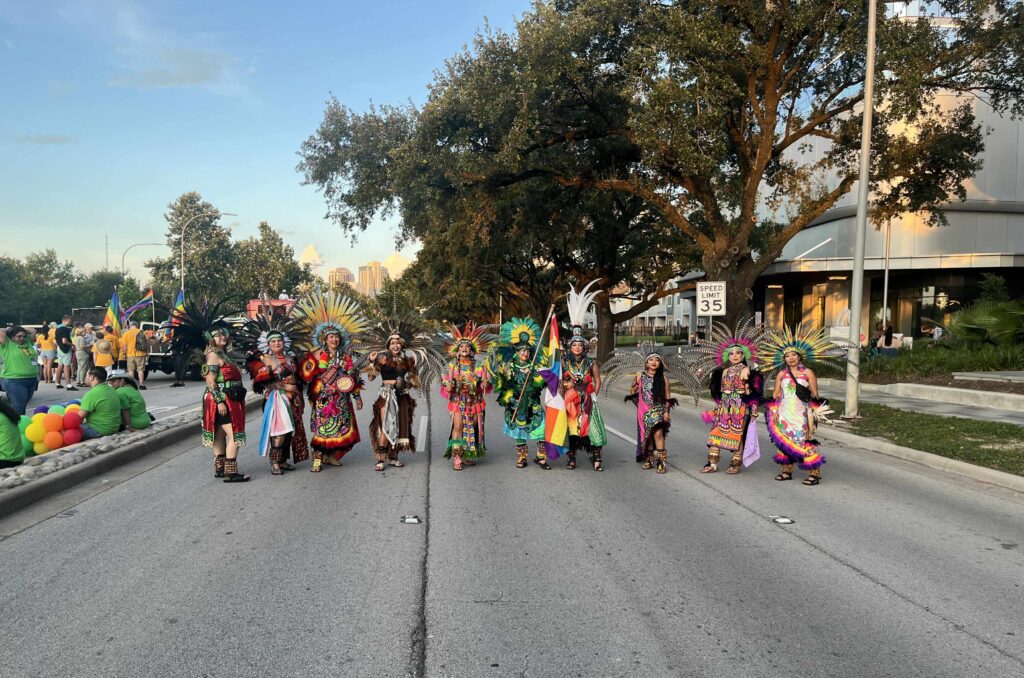
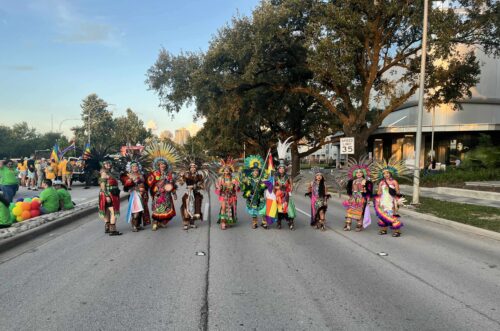
Along Allen Parkway, an arterial road leading to Downtown Houston, parade floats line up in a brilliant wash of colors. The disco sounds of Donna Summer blast on someone’s portable speaker as laughter and chatter fill the street. The floats and performers, encompassing the spectrum of the rainbow through flags, sequins, and glitter, are preparing for the Houston Pride Parade, held annually since 1979.
Toward the end of the line, I wait for the parade to start with my fellow danzantes (dancers). [1] [1] Danza Azteca uses a mix of Spanish and Nahuatl. I am here as a queer and transgender anthropologist and a member of Itzcoatl Tezkatlipoka, a calpulli (group or family) that practices danza Azteca. This artistic spiritual practice combines the huehuetl (a three-legged drum made from hollowed-out tree trunks and stretched hide), atuendo (ceremonial regalia), and movement. The songs and dances originated with the Mexica people of Mexico and reach back to as early as 1525 in Tlaxcallan.
The version that we practice today was brought to California in the 1970s as part of the Chicano Movement. Through this contemporary form of danza Azteca, danzantes physically and spiritually engage with Mexica practices as a connection to their own sense of Indigeneity. It has also historically been utilized as a form of protest—a tradition that Itzcoatl Tezkatlipoka continues today.
Offering danza during the Houston Pride Parade is a show of support for the queer and trans community by Latine and Indigenous danzantes. In Texas, queer, trans, and Latine communities are being persecuted through local and federal legislation. Just days before the 2025 Pride Parade in June, two bills passed by the Texas House legislature set age restrictions for trans mental health care and put in place strict definitions of biological sex. In response to these and other threats, some trans youth and their parents are considering leaving the state to attain gender-affirming health care.
Since early 2025, President Donald Trump’s administration has also targeted Houston’s Latine population as part of their goal of mass deportations. According to the Deportation Data Project, Texas reported over 25,000 arrests in the first five months of the year—making up almost a quarter of all Immigration and Custom Enforcement (ICE) arrests in the U.S.
Amid such threats facing our communities, Itzcoatl Tezkatlipoka has been invited to join FLAS (Fundación Latinoamericana De Acción Social) on their float. They are a Houston-based organization that offers social services such as HIV/STD testing and substance use and behavioral health treatment. As we wait for the parade to start, we adjust the feathers in our copillis (feather headdresses), tighten the laces of our ayoyotes (ankle rattles made from seedpods), and smile for photographs with passersby.
Despite the fear and oppression, we are here.
DANZA AZTECA AS A FORM OF PROTEST
Prior to Spanish colonization of Anahuac (the Valley of Mexico), Mexica people relied on danza Azteca as a form of prayer, education, and community. However, in 1519, Spanish colonizers began eradicating Mexica communities and practices. People who danced had their feet cut off. Those who played the huehuetl lost their hands. People who spoke or sang in Nahuatl lost their tongues. In the face of these threats, danza Azteca turned into an act of resistance to maintain traditions, history, and sciences.
“I love that—knowing that our lineage comes from those revolutionaries,” a fellow Itzcoatl Tezkatlipoka danzante and traditional tattu (tattoo) artist Xixi Xa told me in an interview. “The danzas themselves got saved, through memory, through writing these things inside of the drum[s].”
To keep Mexica traditions alive, stories were etched into the wood of huehuetls, and danza continued to be practiced away from Spanish eyes. Offering danza worked as a form of resistance to colonialism and oppression.
Itzcoatl Tezkatlipoka, one of several calpulli in the Houston area, was created by Maestra Maribel Garcia and two other danzantes in 2020. We trace our tradition to Florencio Yescas, a danzante from Mexico City who first brought the form to the U.S. in the 1970s, then passed it on to danzante Gerardo Selinas, to Maestro Texomazatl, to Maestra Maribel, and now to us.
While danza Azteca originated as a form of resistance to Spanish colonizers and later U.S. assimilation during the Chicano Movement, many calpulli have moved away from incorporating political stances into their practice. Itzcoatl Tezkatlipoka is an exception. Since its start, the calpulli has been active in social justice movements and often attends protests, marches, and vigils.
“A lot of calpullis don’t mix politics,” Maestra Maribel told me during an interview. “And I always felt like, why not?” Under her leadership, one of Itzcoatl Tezkatlipoka’s first marches as a calpulli was a Black Lives Matter protest of George Floyd’s murder by Minnesota police in 2020.
Participating in Houston’s 2025 Pride Parade is part of this protest tradition. For our group, danza Azteca is not only a practice of spirituality, tradition, and regalia; it is an expression of joy and survival. As one danzante put it during our interview, “They didn’t eliminate us. My people stayed underground. They had to, you know, but it’s there.”
She continued, “It’s not just like the feathers and the beautiful, shiny [regalia], it’s more than that. It’s like, all right, remember who you are, and remember you’re not a ‘savage,’ and remember you’re Brown and you’re beautiful. And be proud.”
But being visible is risky, especially for marginalized communities facing government-sanctioned oppression, such as the recent U.S. Supreme Court ruling that effectively allows discriminatory racial profiling of Latine communities.
Danzantes within Itzcoatl Tezkatlipoka have responded to ICE’s heightened presence across Houston with varying levels of concern. Some are paralyzed by the fear of being stopped by an officer and are not attending ensayo (practice). Others are discussing their potential deportation with their children. “If Creator decides it’s my time to go back, I will go back,” one told me. Their children, who have U.S. citizenship, have promised to cross the U.S.-Mexico border and visit them every weekend.
CENTERING JOY AND VISIBILITY
Before the parade, some danzantes voice their concerns about ICE being at the parade. But we take comfort in knowing Itzcoatl Tezkatlipoka members will take care of one another and that other paradegoers will intervene if ICE tries to arrest or harass anyone. One danzante remarks, laughing, “ICE would be silly to show up at Pride.”
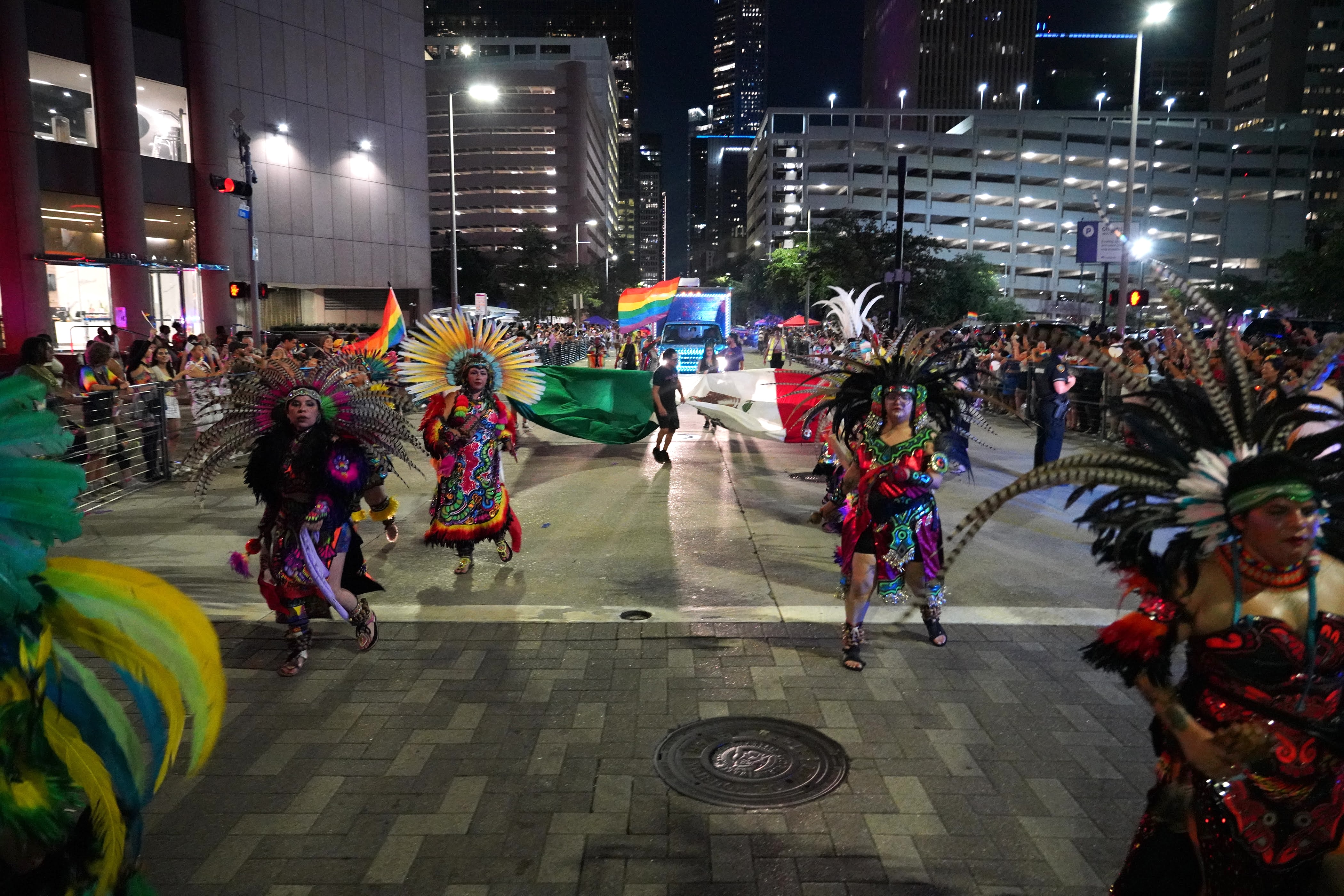
Rather than stay underground, danzantes show up with rainbow Mexican flags, trans flags, and feathers dressed to resemble pride flags. On the back of our regalia are emblazoned the words, “We have always existed.”
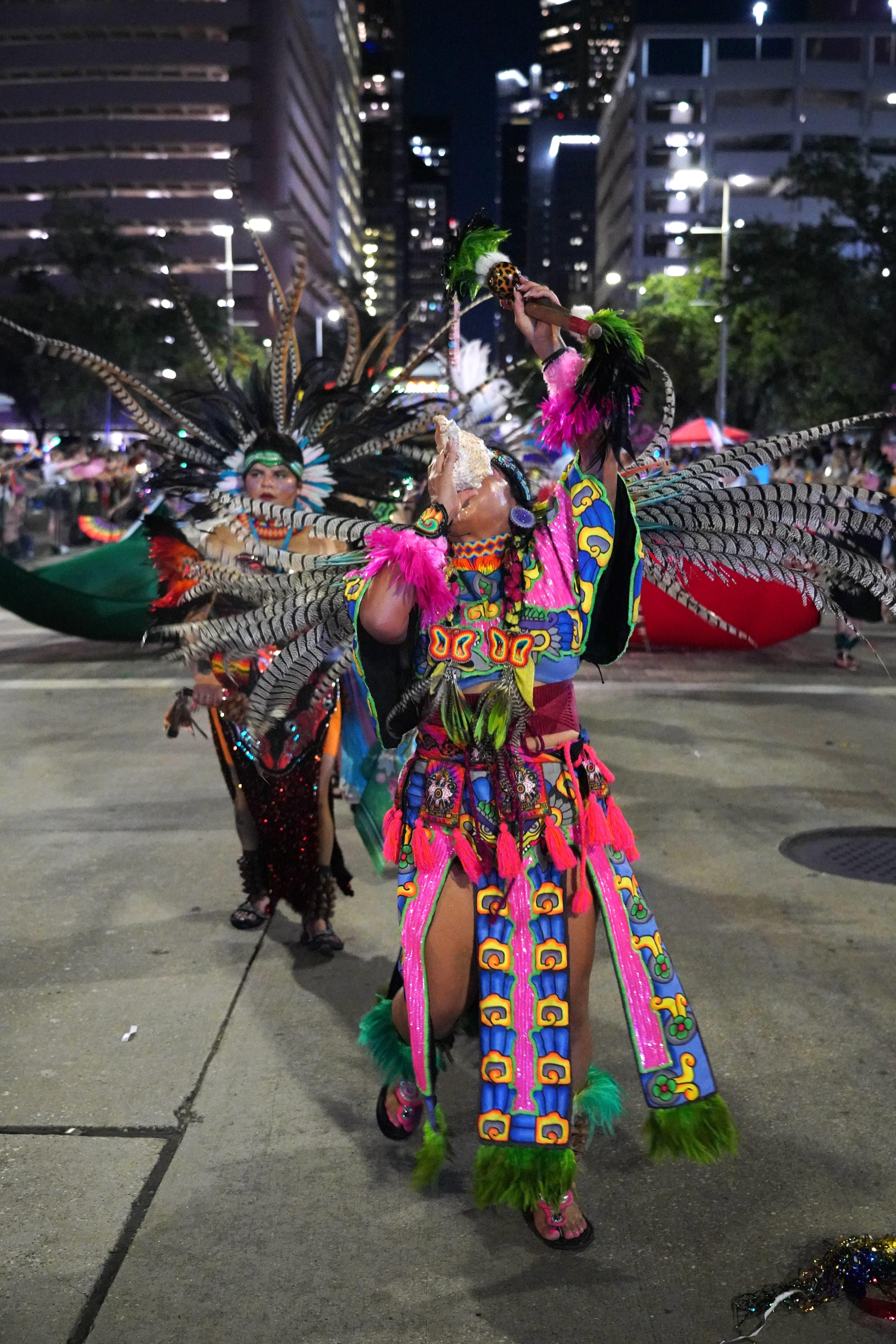
The parade this year has brought out an estimated 700,000 attendees. We begin walking slowly, until the blow of the atecocolli (conch) by Maestra Maribel signals us to move with a flourish. As we dance through the streets of Houston, paradegoers behind barricades cheer and yell in excitement. Many wave pride flags, shouting when they notice a danzante with their same flag.
Maestra Maribel and another danzante alternate between the beats of Paloma (dove), Fuego (fire), and Águila Blanca (bald eagle), danzas with movements suitable to do while marching in a parade. We have practiced each danza, rich in symbolism and meaning, time and time again as forms of prayer. This time, they are being offered to queer and trans Houston.
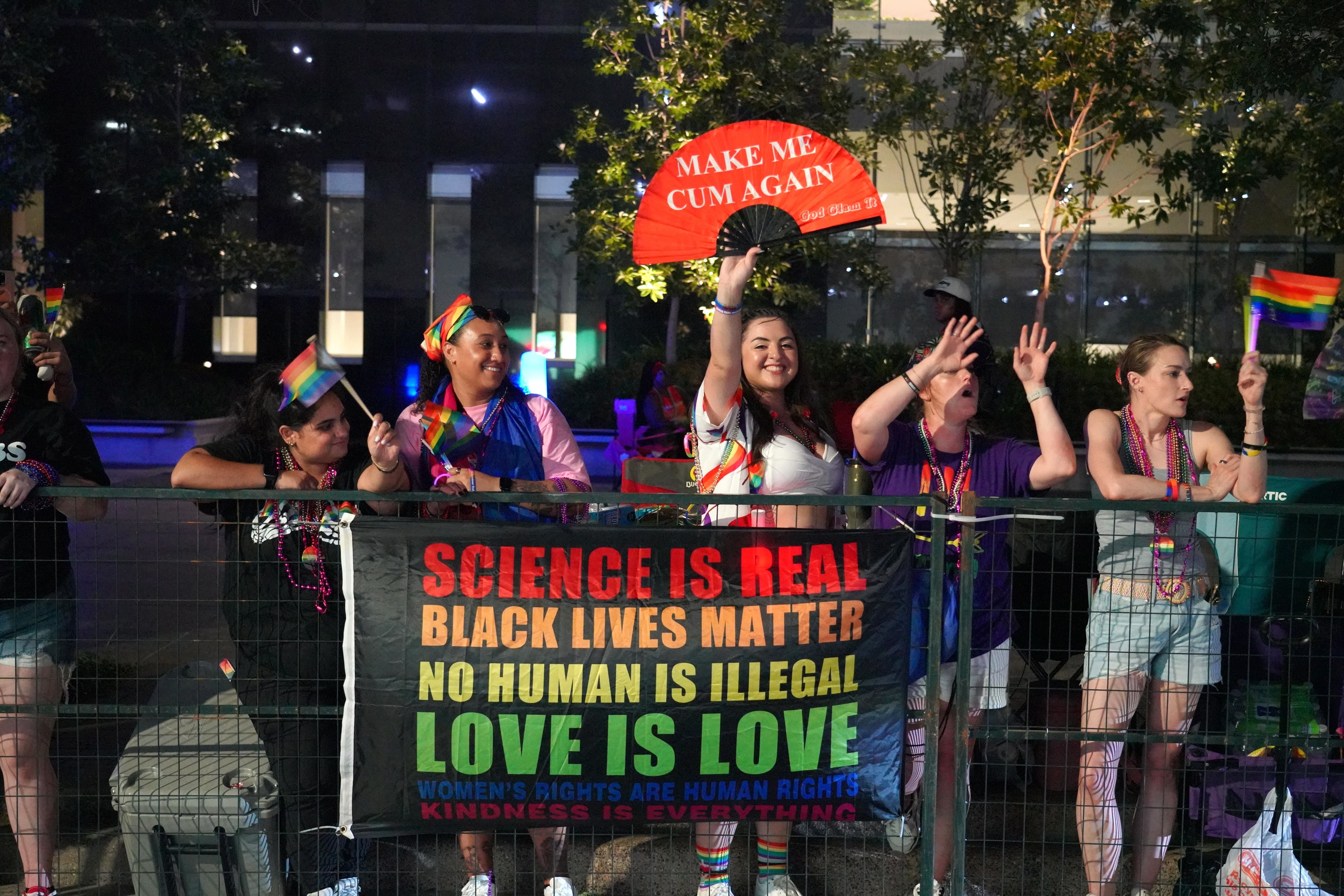
As we pass by a DJ playing their set, they silence the music so the audience can take in the moment. Pride this year is not just a protest in the name of gender and sexual freedom, but also against the government’s oppression of Latine communities. Alongside pride flags, people hold up signs proclaiming “Fuck ICE” and mocking the Trump administration.
As we round the last city corner, my lungs and legs burn, and I’m filled with a sense of hope. All around us we see our mothers, daughters, sisters, siblings, partners, and found-family lines forged through deeply shared connections that go beyond blood.
Maestra Maribel calls us to get into a circle. Xixi and another danzante beat on the huehuetl, and we all step into the first movement, our atuendo and armas (regalia) resounding in the open street.

But before we can fall into a rhythm, we reach the end of the route. Houston Police Department officers on horses and riding in cars and golf carts blare their lights and sirens at us. They corral us out of the street in an unnecessary show of force to tell us the parade has ended. Some of our members are afraid of what the police might do.
Still, we continue to offer danza.
We situate ourselves on a grassy corner across the street from where the officers moved us. Xixi and another danzante pick up the palos (sticks) for the huehuetl, broadcasting the sacred heartbeat of danza Azteca throughout downtown Houston. Maestra Maribel, danzante Genie LaGenie, and others fatigued and sweaty from the parade offer danza to the elements of the earth, the open air, and beyond. I and others kneel, shaking our ayacaxtli (hand rattles) to the beat of the huehuetl.
In the current political climate in the U.S., which has pulled back the curtain and made fascism clear as day, being vibrantly Indigenous, Latine, queer, and trans in public is a form of resistance. There is no form of resistance more powerful than marginalized communities living joyfully in the face of local and U.S. government leaders who would rather we not exist.
I asked one danzante what brings her joy when thinking about Itzcoatl Tezkatlipoka. She responded, “When I’m doing danza and I turn around and I see all the people, it always brings a huge smile.”
As we offer danza on a Houston city corner, under the bright lights of the towering buildings and the deep night sky, I take in every danzante who came in support of Pride. Who showed up despite the potential for ICE to make their presence known. We continue a practice that has persisted since time immemorial. As engaged members of greater Houston, we remind others that our living, breathing community stands strong in the face of oppression.

Syd González is a cultural anthropologist who studies joy, refusal, and masculinity in Latine Houston, Texas. They are a Ph.D. candidate in the department of anthropology at Northwestern University. González’s dissertation centers Itzcoatl Tezkatlipoka danzantes and experiences of kinship, gender, and ethnicity. Follow them on Instagram @sydgonzalezz.
