












Listening to Murmurs
1
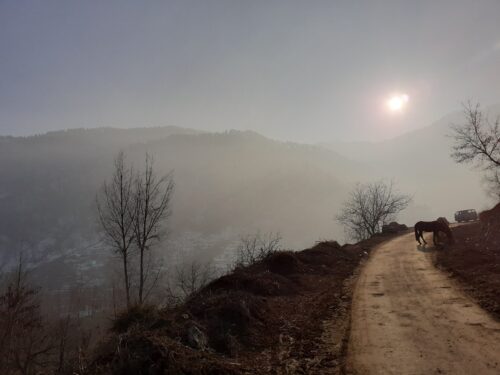
The shared taxi meanders through Tsaar—
resting abode of Nund’e Resh,
the mystic poet who proclaimed
[1]
[1]
Tsaar (also Tsrar, Charar, Charar e Sharief) is the resting abode of Kashmir’s revered mystic poet Shaykh Noor ud din, affectionately also known as Nund’e Resh (or Nund Rishi). Out of reverence, he is honored with titles such as Shaykh al Alam (spiritual guide of the world) or Alamdar e Kashmir (flag bearer of Kashmir).
dying before death
[2]
[2]
In mystical traditions, dying before death, a radical reimagination of death, refers to a transformative process—a seeking—to purify oneself and realign one’s consciousness toward a profound sense of being. See Abir Bazaz’s book Nund Rishi: Poetry and Politics in Medieval Kashmir.
By the window seat,
I listen to endless landscapes fleeting past me
red poppy flowers amid blades of grass
murmur against
a bleak garrison—
break the landscape
broken land
blooming
gulaal
[3]
[3]
In Kaeshur (or Kashmiri), poppy flower is called gulaal.
—flowers of the wasteland
poppy seeds can stay dormant for decades without blooming
upon disruption of the soil, fugitive poppies
suddenly shoot up
a hitherto unknown force
surging forth
As the taxi moves along the errant path
marked with the mystic’s verses
across walls and boards,
my gaze drifts to the partly erased graffiti
[ ] is alive in our hearts
the taxi stereo blares
mohabbat ki keemat ada hum karenge—
“we shall pay the price of love”
sung by Attaullah Khan Esakhelvi
whose songs on cassette tapes
—unrequited love and longing—
echoed tea stalls, buses, and autorickshaws in the nineties
as prison guards broke our erring bodies
2
Close to the mystic’s resting abode,
a potter’s hands aid a quiet revolution
his wheel hums
as he shapes delicate vessels from clay,
sculpting their holding capacity
swaying his head rhythmically to the wheel’s murmur and the kalaam on the radio
[4]
[4]
Kalaam means speech or discourse and also refers to a poet’s literary works or a particular piece of poetry or its musical rendition(s).
tender forms emerge
whirling against the frangibility of their own beings
“Ye chu sir-e-khoda”—
“it is divine secret,”
the potter tells me:
“a laborious process,
sincere work
bearing divine’s grace
the earth carries multitudinous veins,
we work with one of them
there are different forms of clay—
fourteen, in the nearby hill alone
we know each of these veins intimately—
clay that holds and the one that falls apart”
3
Peering into the clay vessel’s void,
I gather Nund’e Resh’s words:
ژالُن چُھی وُزملہٕ تہٕ ترٛٹے
ژالُن چھُی منٛد نٮ۪ن گٹہ کار
ژالُن چھُی پربتس کرُن اٹے
ژالُن چھُی منٛز اتھس ہیوٚن نار
ژالُن چھُی پان کڈُن گرٛٹے
ژالُن چھُی کھینٚۍ یکہ وٹہ زہرخار
[5]
[5]
G.N. Adfar, Alchemy of Light, Volume II (G.N. Adfar, Quaf Printers, 2013), 323. Translation mine. See also Abu Nayeem, Noor Nama: Kulliyat e Shaykh al-Alam (Sheikh Mohammad Usman and Sons Tajran’e e Kutub, 2006), 20.
“Endurance is lightning and thunder
Endurance is darkness at noon
Endurance is lugging a mountain on one’s back
Endurance is cradling fire in one’s palm
Endurance is being milled to nothing
Endurance is gulping heaps of poison all at once”
[6]
[6]
The last line is rendered differently in some versions, which could be translated as “endurance is swallowing poison (veh) and pain (gar),” and gar bears the double meaning of both pain and poison. See Moti Lal Saqi, Kulliyat-e Shaykh al-Alam, 35.
4
As we walk through Tsaar, M. recalls
the siege of 1995,
[7]
[7]
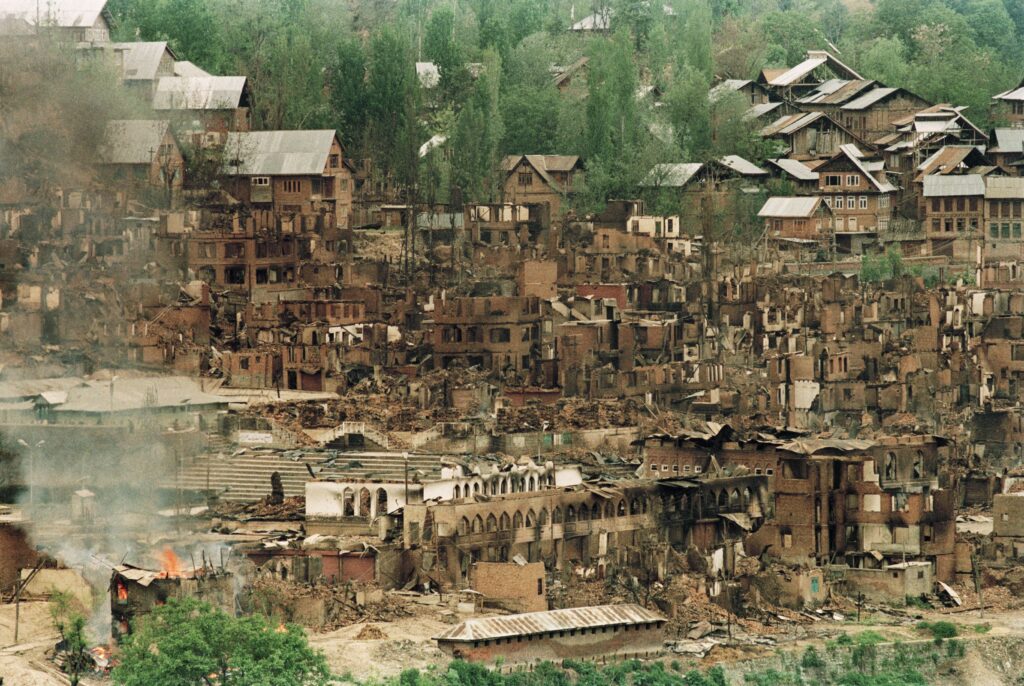
Following a monthslong siege and a standoff between tens of thousands of Indian troops and militants—about 150, according to The New York Times, or 70, according to The Washington Post—Shaykh Noor ud din’s mausoleum and the adjoining mosque, a 15th-century wooden structure, went up in flames on May 11, 1995. More than 1,000 homes and hundreds of shops were destroyed in Tsaar. According to The Washington Post, two explosions at 2:00 a.m. on May 11 ignited the fires, and on May 12, when the army brought in Indian and foreign journalists, locals accused the army of destroying the town—including the mosque and the mausoleum—using gunpowder and mortars. By 1995, the army setting fire to entire neighborhoods had become a common technique of terror. See Shiraz Sidhva, “Kashmir Peace Hopes Go Up in Smoke,” Financial Times, May 15, 1995. The mosque and the shrine were later rebuilt.
a sea of people leaving
Thousands of homes,
mystic-poet’s shrine, and its adjacent mosque—
entire neighborhoods
going up in flames
Dwellers returning to ruins and corpses
grief’s gnawing teeth
Sounds of mourning and protest echoing
Tsaar—
ghost town
archive of debris,
gunpowder, mortar—
veins of the earth, now acrid
sir e khoda, wounded
abode of lost homes
present continuous
present perfect continuous
As the day departs,
M. invites me to her friend’s wedding nearby
fragile moonlight enshrouds Tsaar
the smoke of isband lingers in the air—
[8]
[8]
Peganum harmala, or wild rue, is burned on special occasions in Kashmir.
it is the night of henna
women gather in a circle and begin clapping
gently at first
each summoning a fragment,
swaying their bodies—
I listen to murmurings
rising over the racket of History
until History is inaudible
fragment after fragment, the women suture a song
elegizing
the loss of community
and compassion
that, as they say,
marked the burning of Tsaar:
“They burnt down Tsaar, obliterating it to smithereens
Laying bare our wounds, forever to bear
They burnt down Tsaar, obliterating it to smithereens
We witnessed, right in front of us, how it was set ablaze
They burnt down Tsaar, obliterating it to smithereens
We committed everything to our memory
They burnt down Tsaar, obliterating it to smithereens
We took note of the perpetrators
They burnt down Tsaar, obliterating it to smithereens
That togetherness, we lost forever …”
5
As I walk inside the mosque next to the mystic’s masoleum,
a wayfarer entrusts me with a mound of amorphous clay
and disappears, his mutterings trailing behind him
6
With a flick of the kraal’e pann
[9]
[9]
A potter’s string used to separate or cut off a finished vessel from the wheel.
the potter severs the vessel from the turning wheel,
gently resting the form on the ground
Clay vessel’s being still resonant with the wheel’s gyrations
“Dopmai na ye chu sir e khoda?” the potter murmurs—
“Didn’t I say it is a divine secret?”

Uzma Falak was born and raised in Srinagar, Kashmir. She is a doctoral student in anthropology at the University of Heidelberg and a lecturer at the University of Tübingen. Her academic work, poetry, essays, and reportage have appeared in several publications, such as English Language Notes, Anthropology and Humanism, The Baffler, and collections such as Poetry as Evidence, Insurgent Feminisms: Writing War, Can You Hear Kashmiri Women Speak?, among others. In 2017, she won an honorable mention in the Society for Humanistic Anthropology’s Ethnographic Poetry Award. Her writings, visual and sound work have been showcased at several galleries, festivals, universities, and theaters such as the Tate Modern Exchange, Rizq Art Initiative, Art Gallery of Guelph, Rice Cinema, among others. Recently, she was an artist-in-residence at Melbourne’s Liquid Architecture as part of the cohort Capture All: A Sonic Investigation, focused on exploring sound/listening as resources of power, capture, and extraction. Falak is the 2025 SAPIENS digital poet-in-resident.
